
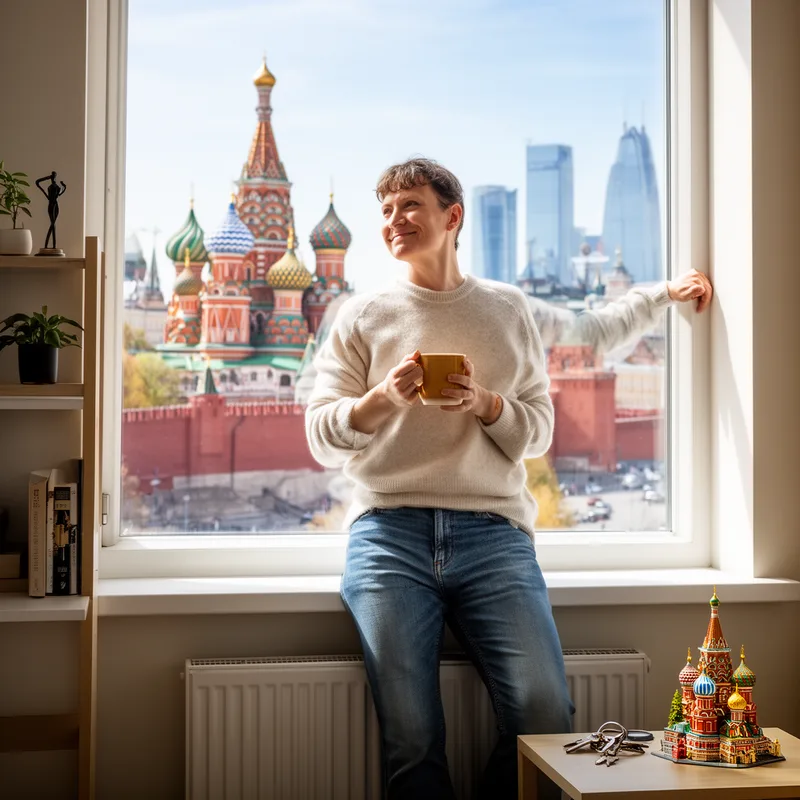
Muscovite
 3
6.2

- noun
- /ˈmʌskəˌvaɪt/
- Dmitri Gavrilov is one Muscovite who says he has benefited from the market reforms introduced by President Yeltsin.
- a young Muscovite
- an average Muscovite
- an old Muscovite
Loading YouTube…
Watch on YouTubeBut some years ago, a Muscovite called Boris Mikhailovich Russakov discovered a new kind of elementary particle.
- But some years ago, a Muscovite called Boris Mikhailovich Russakov discovered a new kind of elementary particle.
Examples
-
On June 21, 1941, the day before Nazi Germany sprang its surprise invasion of the Soviet Union, Natalia Peshkova, a 17-year-old Muscovite, graduated from high school with hopes of becoming a journalist.
-
So did this, did this serfs belong to the Muscovite state, Right.
-
You look to me like a Muscovite.
-
At the risk of offending you, I must tell you you're as smart as a native Muscovite.
-
He is a tall, corpulent Muscovite with smooth, dark hair.
Fiction book (2002) -
But some years ago, a Muscovite called Boris Mikhailovich Russakov discovered a new kind of elementary particle.
-
Vladimir Mironov is another Muscovite on the move.
Synonyms
 3
1.0
A person who comes from Russia
Surface Forms
Morphology
Muscovite = Moscow (semi-transparent) = Muscov + ite
Formed with the demonym suffix '-ite' from 'Moscow' but the stem alters to 'Muscov-', which may not be immediately obvious to learners.
Etymology
Muscovite comes from the city name Moscow, called Moskva in Russian, plus the ending -ite, which means 'person from' or 'living in'. So a Muscovite is a person from Moscow.