

Muscivora forficata
- noun
- Specialized
- The distinctive forked tail of the Muscivora forficata makes it easy to identify in flight.
Examples
-
The Muscivora forficata is often spotted performing dazzling aerial displays during mating season.
-
Bird watchers travel to Texas each spring to observe flocks of Muscivora forficata.
-
Look at that Muscivora forficata flying gracefully!
-
The Muscivora forficata is often seen perched on fences.
-
Bird watchers travel to Texas each spring to observe flocks of Muscivora forficata.
-
The Muscivora forficata is often spotted performing dazzling aerial displays during mating season.
-
The distinctive forked tail of the Muscivora forficata makes it easy to identify in flight.
Synonyms

A grey bird with a long forked tail and a white breast with pink and red markings
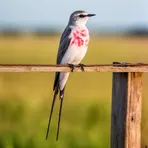
A thin gray bird with a very long forked tail and a white chest with pink and red marks
Surface Forms
Morphology
Muscivora + forficata
This is a Latin binomial (taxonomic) name functioning primarily as a label rather than a compositional English phrase; a B1 learner who knows 'Muscivora' (genus of insect-catching birds) but not 'forficata' cannot derive 'scissor-tailed flycatcher' from the parts. Scientific epithets are language-specific and often opaque to learners because the second element here is not a familiar English morpheme and the overall meaning is not transparently built from ordinary English vocabulary.
Etymology
Muscivora forficata may come from Latin words: Muscivora meaning 'fly-eater' and forficata meaning 'scissor-shaped'. This gives a clear picture of a bird that catches flies and has a long, forked tail like scissors, so it is called the 'scissor-tailed flycatcher' today.

