

Muscardinus avellanarius
- noun
- Specialized
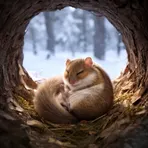
- Did you know that the Muscardinus avellanarius hibernates for months?
Examples
-
The Muscardinus avellanarius is often found in hazel trees.
-
The population of Muscardinus avellanarius has declined in many parts of Europe due to habitat loss.
-
Muscardinus avellanarius is protected by law in several countries because of its vulnerable status.
-
Researchers observed the feeding habits of Muscardinus avellanarius in a restored woodland area.
-
The population of Muscardinus avellanarius has declined in many parts of Europe due to habitat loss.
-
Researchers observed the feeding habits of Muscardinus avellanarius in a restored woodland area.
-
Muscardinus avellanarius is protected by law in several countries because of its vulnerable status.
Synonyms
 3
6.9
3
6.9

A small furry animal like a mouse with a bushy tail that sleeps through winter
Surface Forms
Morphology
Muscardinus + avellanarius
This is a Latin scientific binomial rather than a transparent English phrase; the constituent elements are taxonomic labels (one technical, the other not found in the learner dictionary) and do not convey the everyday meaning 'hazel dormouse' to a typical B1 learner. Even if a learner recognised one element as a genus, the species epithet is obscure and the overall referent is a proper name, so the meaning is not derivable from the parts.
Etymology
Muscardinus avellanarius comes from Latin words: Muscardinus was a word for a small 'dormouse' and avellanarius means 'of the hazel'. The name fits because this little, golden-brown animal lives in hazel trees and eats hazelnuts, so the words help you remember the species.