
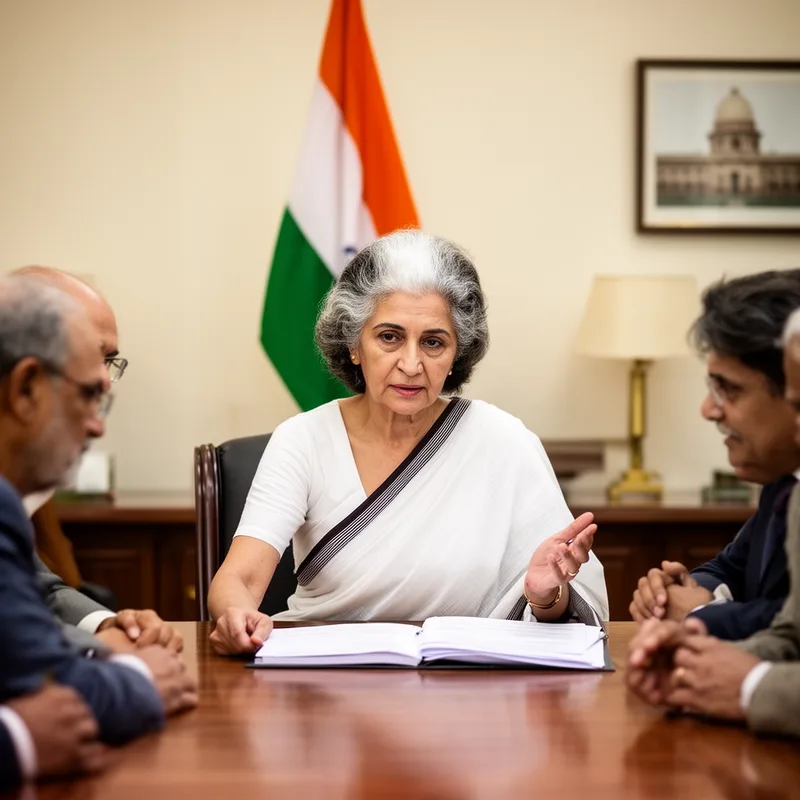
Mrs. Gandhi
 1
5.3

- proper noun
- The Syndicate selected Jawaharlal Nehru's daughter, Mrs. Gandhi, who had served as her father's advisor and in Shastri's cabinet, to be prime minister.
- Mrs. Gandhi's emergency
Examples
-
Two days later, in the early hours of 26 June 1975, Mrs. Gandhi declared a state of national emergency.
Academic text (1997) -
After an ignominious 20-month emergency rule, Mrs. Gandhi was soundly defeated by a hastily assembled coalition of political parties and protest movements.
Academic text (1997) -
This proposal was reiterated when Mrs. Gandhi became prime minister for the second time.
Academic text (1997) -
Mrs. Gandhi took personal control of Congress affairs, rather than allowing conflicts to be resolved at lower levels as Nehru had.
Academic text (1997) -
In this troubled economic environment, the Allahabad High Court found Mrs. Gandhi guilty of violating minor election regulations.
Academic text (1997) -
Mrs. Gandhi's response to these and other economic crises included the nationalization of numerous labor-intensive industries, including coal mines and textile mills.
Academic text (1997) -
During the emergency, Mrs. Gandhi used the president's rule in the only two non-Congress-controlled states, Gujarat and Tamil Nadu, to bring the entire country under direct dictatorial rule from Delhi.
Academic text (1997) -
Mrs. Gandhi dismissed and appointed Congress chief ministers and exercised, through the Office of the President, the government's prerogative to dismiss the opposition in state assemblies.
Academic text (1997) -
On 14 January 1980, after a massive electoral victory, Mrs. Gandhi returned to power as India's Prime Minister.
-
Mrs. Gandhi played a crucial role in shaping India's foreign policy during her terms in office.
Synonyms
 9
4.3
India's first woman prime minister who served in the 1960s to 1980s
 3
4.1
Indian politician who served as Prime Minister of India from 1966 to 1977 and 1980 to 1984
Surface Forms
Morphology
The combination of the title 'Mrs' and the surname 'Gandhi' transparently yields the basic sense 'a married woman named Gandhi', which a B1 learner who knows both words can infer. However, the specific identity and biographical information (that this refers to Indira Gandhi, the Indian prime minister with particular dates) require world knowledge beyond the constituents, so the expression is only partially transparent.
Etymology
Mrs. Gandhi is the common name for Indira Gandhi, the daughter of Jawaharlal Nehru who served as prime minister of India. The title 'Mrs.' shows she was a married woman and 'Gandhi' is her family name, and because she led India through big changes and was later killed, the name 'Mrs. Gandhi' now usually refers to that famous prime minister.