
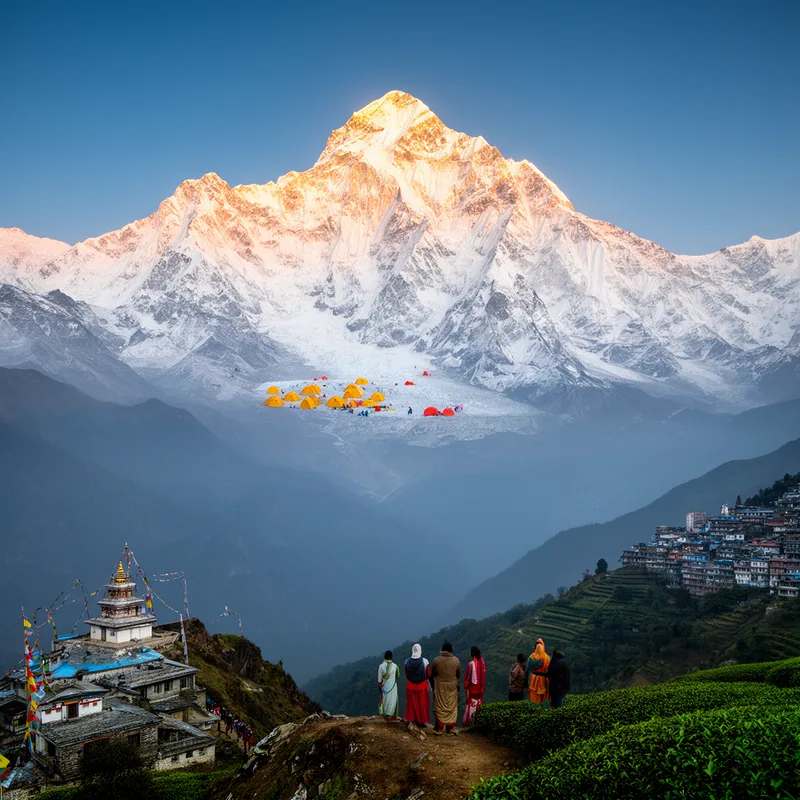
Mount Kanchenjunga


 1
7.7
- proper noun
- Many climbers dream of scaling Mount Kanchenjunga due to its challenging ascent and remote location.
Examples
-
The snow-capped peak of Mount Kanchenjunga can be seen from Darjeeling on clear days.
-
Local legends hold Mount Kanchenjunga as a sacred mountain, revered by communities on both sides of the border.
-
Many climbers dream of summiting Mount Kanchenjunga.
-
Have you ever heard of Mount Kanchenjunga?
-
Local legends hold Mount Kanchenjunga as a sacred mountain, revered by communities on both sides of the border.
-
Many climbers dream of scaling Mount Kanchenjunga due to its challenging ascent and remote location.
-
The snow-capped peak of Mount Kanchenjunga can be seen from Darjeeling on clear days.
Synonyms
 1
8.9
A mountain in the Himalayas on the border of Nepal and Sikkim, the third highest peak in the world
 1
9.9
A very high mountain in the Himalayas on the border of Nepal and India, the third highest in the world
 1
9.1
A very high mountain in the Himalayas on the border between Nepal and Sikkim, the third highest in the world
A mountain that is the third highest in the world on the border between Nepal and Sikkim, India
Surface Forms
Morphology
The compound follows the regular naming pattern 'Mount + [proper name]' where 'mount' means a mountain and 'Kanchenjunga' is the specific name; thus the phrase directly denotes the mountain called Kanchenjunga. This composition is cross-linguistically common and easily understood by a B1 learner who knows both constituents (even if they might not know its exact rank or height).
Etymology
Mount Kanchenjunga comes from a local Himalayan language; Kanchenjunga is said to mean 'the five treasures of the great snow' because the mountain has five main peaks that people saw as sacred treasures. This image of five holy peaks helps explain why the name shows the mountain's special, sacred status today.