
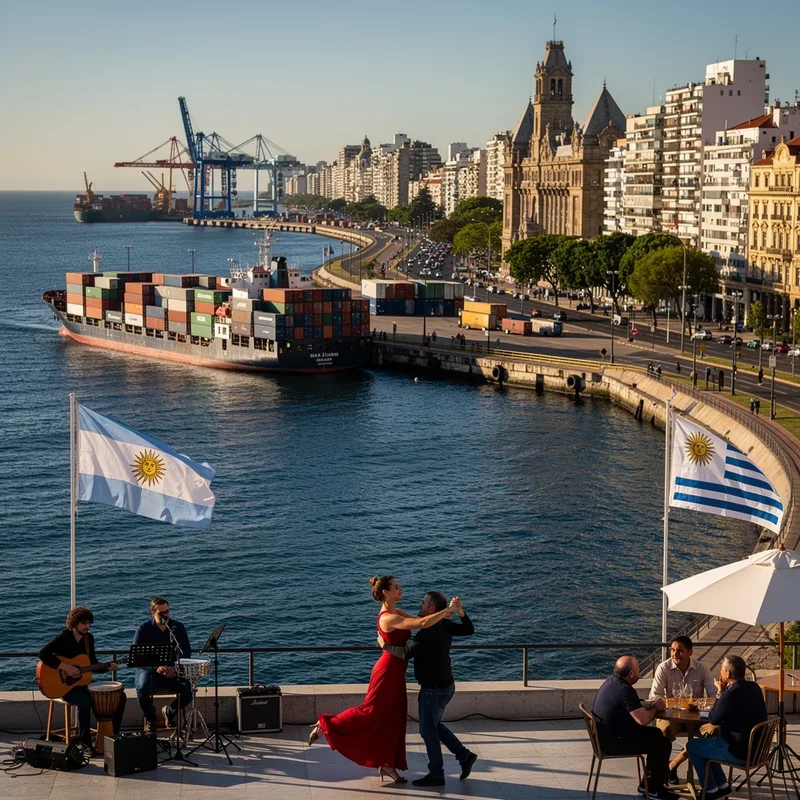
Montevideo
 4
4.2

- proper noun
- /ˌmɒnteɪˈviːdeɪoʊ/
- Eventually, the commission reached Montevideo in November 1933.
- Montevideo, Uruguay
- Montevideo Convention
Loading YouTube…
Watch on YouTubeWe are going back to Montevideo, about a three hour drive to catch our flight just.
- We are going back to Montevideo, about a three hour drive to catch our flight just.
Examples
-
The two ships proceeded to Montevideo for refitting and reprovisioning before the long haul across the Pacific.
Fiction book (1991) -
Television has been available to Uruguayans since the three commercial stations in Montevideo began broadcasting in 1956.
Academic text (1990) -
We are going back to Montevideo, about a three hour drive to catch our flight just.
-
When I woke up, we were near Montevideo and her seat was empty.
Fiction book (1994) -
In the capital, Montevideo, the last snow event happened in June 1980.
Blog text (29) -
Last week in Montevideo made us much more grateful for lounges.
-
The city of Montevideo alone boasted over three hundred sports arenas in 1896, the year of the first Olympic Games.
Academic text (1995) -
Foreign Minister Shevardnadze's visit to Montevideo in 1987 lent considerable momentum to this aspect of the bilateral relationship (Ehrmann, 1988).
Academic text (1990) -
Gabriel H. Diaz Maggioli is a teacher, teacher educator, and writer of EFL in Montevideo, Uruguay.
Academic text (1994) -
After a brief stay in Montevideo, he continued his journey back to France.
Surface Forms
Etymology
The word Montevideo comes from Spanish and Portuguese roots: monte meaning 'hill' or 'mountain', and a popular story links video to 'I saw'. So you can remember Montevideo as 'the hill I saw', a name sailors gave to the coastal hill where the city grew.