

Monodon monoceros
- noun
- /ˈmɒnədɒn ˌmɒnəˈkɛrəs/
- Specialized
- The Monodon monoceros is known for its distinctive tusk.
Examples
-
The unique tusk of Monodon monoceros has intrigued marine biologists for centuries.
-
The Arctic researcher focused her study on the behavior of Monodon monoceros during the winter months.
-
Scientists observed a pod of Monodon monoceros migrating through the icy waters of the northwest passage.
-
Did you know that Monodon monoceros can dive to depths of over 1,500 meters?
-
Scientists observed a pod of Monodon monoceros migrating through the icy waters of the northwest passage.
-
The Arctic researcher focused her study on the behavior of Monodon monoceros during the winter months.
-
The unique tusk of Monodon monoceros has intrigued marine biologists for centuries.
Synonyms

 4
8.4
4
8.4

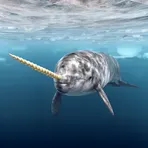
A small Arctic whale with a long spiral tusk on its head

 1
8.5
1
8.5
A small Arctic whale whose males have a long twisted tusk on their heads
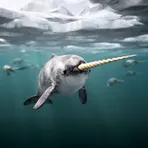
A small Arctic whale whose male has a long spiral tusk from its upper jaw
Surface Forms
Morphology
The binomial combines 'Monodon' (a whale genus) with 'Monoceros' (one‑horned), so a learner who knows both constituents can infer 'one‑horned whale' and therefore identify the narwhal. Scientific Latin names are compositional here rather than idiomatic, making the meaning directly derivable from the parts.
Etymology
The scientific name Monodon monoceros comes from Greek words: mono meaning 'one', don meaning 'tooth', and monoceros meaning 'one-horned'. It describes the male narwhal's long, spiral tusk that looks like a single horn, so the name shows the animal's most famous feature.