
Mohorovicic discontinuity
- noun
- /ˌmoʊhəˈroʊvɪtʃɪk ˌdɪskənˈtɪnʊɪti/
- Specialized
- The depth of the Mohorovicic discontinuity varies between oceans and continents.
Examples
-
Seismic waves travel faster below the Mohorovicic discontinuity due to the denser mantle material.
-
Geologists study the Mohorovicic discontinuity to understand Earth's structure.
-
Geologists often refer to the Mohorovicic discontinuity simply as the Moho.
-
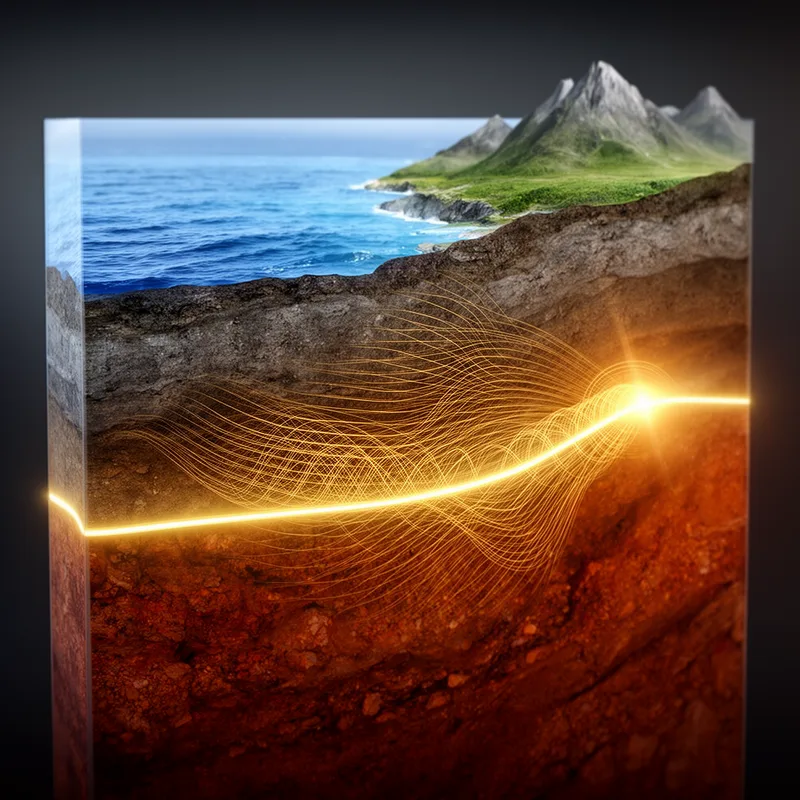
The Mohorovicic discontinuity separates the crust from the mantle.
-
The Mohorovicic discontinuity, or Moho, marks the transition between the Earth's crust and the mantle where seismic wave velocities increase significantly.
-
Seismologists study the Mohorovicic discontinuity to better understand the composition and behavior of the Earth's interior.
-
The depth of the Mohorovicic discontinuity varies across the globe, influencing geological research and the study of tectonic activity.
Synonyms


 1
9.8
1
9.8
A boundary under the Earth's surface between the crust and mantle where rocks change
Surface Forms
Morphology
Mohorovicic + discontinuity
The element 'Mohorovicic' is a proper name (a scientist) with no lexical meaning a learner can use, while 'discontinuity' only signals a gap or boundary. A B1 learner knowing both words might guess this refers to some kind of boundary but would not be able to derive the specific geological meaning (the crust–mantle boundary) without prior domain knowledge.
Etymology
Mohorovicic discontinuity comes from the Croatian scientist Andrija Mohorovicic, who noticed that earthquake waves suddenly change speed below the Earth's crust. That sudden change, the discontinuity, is why the term now means 'the boundary between the crust and the mantle'.