
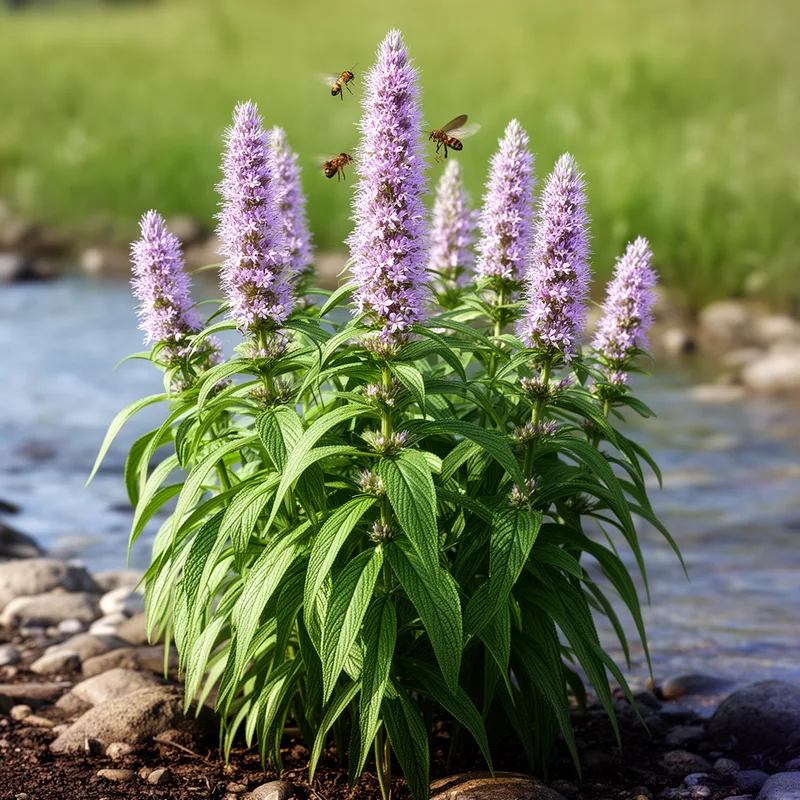
Mentha longifolia
- noun
- Specialized
 :
menta de hojas largas
:
menta de hojas largas
- The leaves of Mentha longifolia are sometimes used in herbal teas and traditional remedies.
Examples
-
Mentha longifolia is often found growing along riverbanks and wet meadows in its native range.
-
Gardeners appreciate Mentha longifolia for its resilience and ability to attract pollinators.
-
I found some Mentha longifolia growing by the river.
-
The Mentha longifolia has a strong minty aroma.
-
Mentha longifolia is commonly used in herbal remedies due to its potent flavor and fragrance.
-
The long leaves of Mentha longifolia give it a distinctive appearance in the garden.
-
Mentha longifolia thrives in moist environments and is often found near streams.
Synonyms

A mint plant with strong smell and spikes of small flowers that attract bees
How Aromatic
- Specialized

- Specialized
- Specialized
- Specialized
- Specialized
Surface Forms
Morphology
Mentha + longifolia
The name is compositionally built from Mentha (mint) + longifolia (Latin for 'long‑leaved'), so the sense 'a mint with long leaves' is derivable in principle. However, 'longifolia' is a Latin botanical form not part of everyday English and is absent from the provided dictionary entry, so an average B1 learner would not reliably recognize the constituent meaning without specialized/Latin knowledge.
Etymology
Mentha longifolia comes from two Latin words: Mentha meaning 'mint' and longifolia meaning 'long leaf'. So the name gives a clear image of a wild mint with long leaves and helps you remember this plant.

