

Melanitta nigra
- noun
- Specialized
- The Melanitta nigra is often seen diving for food in shallow coastal waters.
Examples
-
Conservation efforts have helped stabilize some populations of Melanitta nigra in Europe.
-
The Melanitta nigra is often seen along the coasts of Norway.
-
Birdwatchers gathered to observe a flock of Melanitta nigra during their annual migration.
-
Many birdwatchers travel to see the Melanitta nigra in its natural habitat.
-
Birdwatchers gathered to observe a flock of Melanitta nigra during their annual migration.
-
Conservation efforts have helped stabilize some populations of Melanitta nigra in Europe.
-
The Melanitta nigra is often seen diving for food in shallow coastal waters.
Synonyms

 1
9.9
1
9.9

A large black duck that dives for food near northern coasts


 1
9.9
1
9.9
A large black diving duck found in northern coastal waters
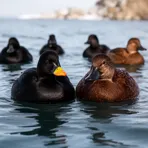
A sea duck with black males and brown females
Surface Forms
Morphology
Melanitta + nigra
This is a Latin binomial (scientific) name rather than a compositional English phrase, so its meaning ('a species of sea duck') is not predictably derived from ordinary English constituents; one constituent ('nigra') is even missing a dictionary gloss here. Even if 'Melanitta' were recognised as a genus or 'nigra' as a Latin/Romance root meaning 'black', that etymological knowledge is specialized and not available to an average B1 learner, so the phrase is not transparently interpretable.
Etymology
The scientific name Melanitta nigra comes from old words meaning 'duck' and 'black', where Melanitta refers to the duck part and nigra to the black part, so the name paints the picture of a dark sea duck and is used for the 'common scoter' today.