

Maxwell-Boltzmann distribution law
- noun
- /ˈmækswɛl ˈbɔltsbɑn dɪstrɪˈbjuːʃən lɔ/
- Specialized
- The Maxwell-Boltzmann distribution law predicts how particles in a gas move at different speeds.
Examples
-
According to the Maxwell-Boltzmann distribution law, energy distribution varies with temperature.
-
The Maxwell-Boltzmann distribution law explains molecular behavior in gases.
-
In introductory physics, students often encounter the Maxwell-Boltzmann distribution law when studying thermodynamics.
-
Understanding the Maxwell-Boltzmann distribution law is crucial for explaining the behavior of ideal gases.
-
In introductory physics, students often encounter the Maxwell-Boltzmann distribution law when studying thermodynamics.
-
Understanding the Maxwell-Boltzmann distribution law is crucial for explaining the behavior of ideal gases.
-
According to the Maxwell-Boltzmann distribution law, energy distribution varies with temperature.
Synonyms
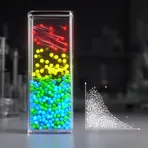
A physics law that shows how energy spreads among gas particles, with high energies less likely than low ones
Surface Forms
Morphology
Maxwell-Boltzmann + distribution + law
The headwords 'distribution' and 'law' signal a scientific rule about how something is distributed, so a B1 learner who knows those words can infer it is a law concerning a distribution. However, 'Maxwell-Boltzmann' is a technical proper name that does not convey the specific domain (molecular energies in gases) to non-specialists, so the full meaning requires subject knowledge.
Etymology
Maxwell-Boltzmann distribution law is named after two scientists and gives a simple picture: imagine many tiny balls called particles moving at different speeds, with most near the middle and only a few very slow or very fast. That's why it shows how the 'energies' or 'speeds' of gas particles are 'spread out' when the gas is at the same 'temperature'.

