
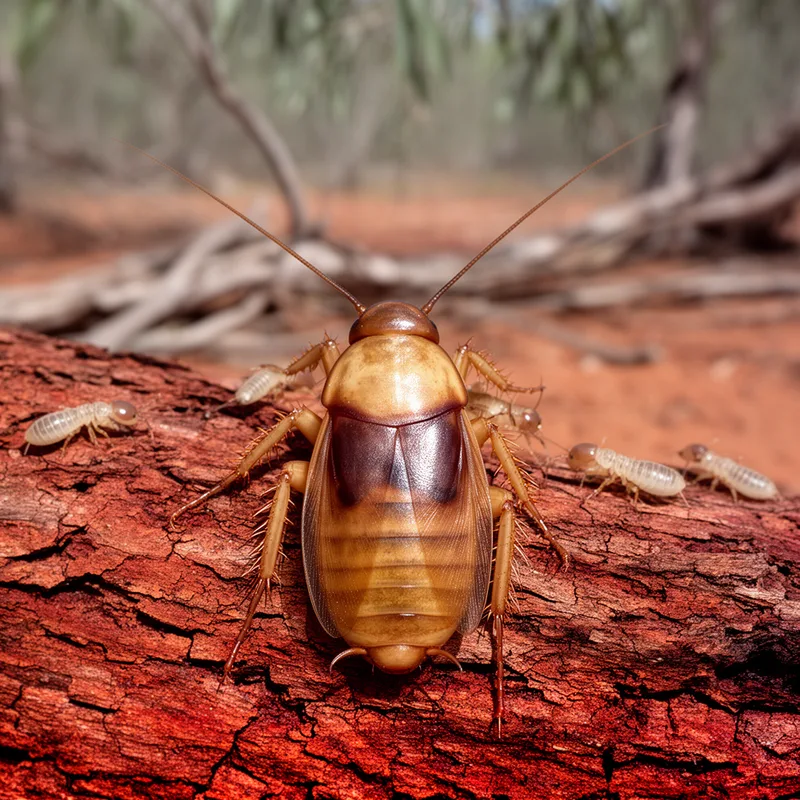
Mastotermes darwiniensis
- noun
- Specialized
- Unlike most termites, Mastotermes darwiniensis retains several ancestral traits reminiscent of cockroaches.
Examples
-
The Mastotermes darwiniensis is often studied for its primitive characteristics among termites.
-
The Mastotermes darwiniensis is often referred to as a living fossil.
-
Researchers discovered a colony of Mastotermes darwiniensis in northern Australia.
-
Have you ever seen a Mastotermes darwiniensis up close?
-
Researchers discovered a colony of Mastotermes darwiniensis in northern Australia.
-
The Mastotermes darwiniensis is often studied for its primitive characteristics among termites.
-
Unlike most termites, Mastotermes darwiniensis retains several ancestral traits reminiscent of cockroaches.
Surface Forms
Morphology
Mastotermes + darwiniensis
As a Linnaean binomial, the form 'Mastotermes darwiniensis' transparently signals a species in the genus Mastotermes, so a learner who knows 'Mastotermes' (a termite genus) and the epithet (commonly interpreted as ‘of Darwin’ or locality-related) can infer it is a particular termite species. However, the full definition given (large Australian termite, only living species, living fossil, links to cockroaches) contains specialized biological information that cannot be deduced from the name alone, so the expression is only partially predictable.
Etymology
Mastotermes darwiniensis gets its name from its old kind and its place: Mastotermes shows it is a very ancient type of termite, and darwiniensis points to Darwin in northern Australia where it was found. Because it keeps many cockroach-like traits, people call it a 'living fossil', so the name reminds us it is a large, primitive Australian termite that links cockroaches and termites.

