
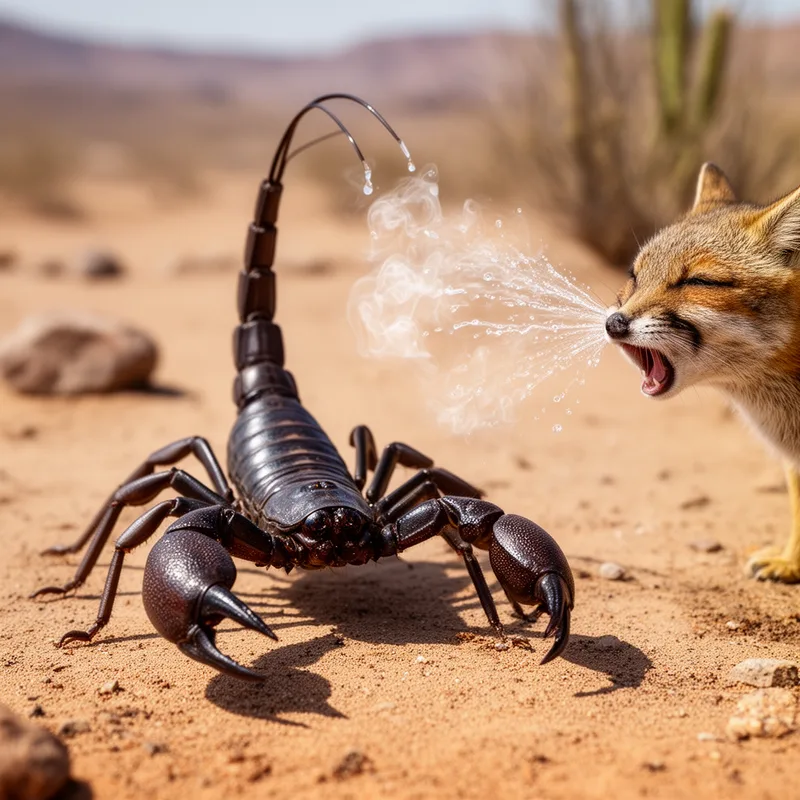
Mastigoproctus giganteus
- noun
- /ˌmæstɪɡəˈprɒktəs dʒɪˈɡæntɪəs/
- Specialized
- The Mastigoproctus giganteus can spray a vinegary liquid as a defense mechanism.
Examples
-
Many people mistake the Mastigoproctus giganteus for a true scorpion, though it is harmless to humans.
-
Biologists studied the habitat of Mastigoproctus giganteus in the deserts of Texas.
-
The Mastigoproctus giganteus is often found in the desert regions.
-
Did you know that the Mastigoproctus giganteus can emit a vinegary odor?
-
The Mastigoproctus giganteus is known for emitting a strong vinegary odor when threatened.
-
Many people confuse the Mastigoproctus giganteus with scorpions, but it poses no danger to humans.
-
In the wild, the Mastigoproctus giganteus uses its defense mechanism to spray a vinegary liquid.
Synonyms



 1
9.9
A large animal like a scorpion that gives off a strong vinegar smell when frightened and is harmless to people
 1
9.6
A small animal like a spider with a long thin tail and no sting

An animal like a scorpion with a long thin tail and no sting
Surface Forms
Morphology
Mastigoproctus + giganteus
The binomial combines the genus name with the Latin adjective 'giganteus' (cognate with 'giant'/'gigantic'), so a learner who knows both constituents can infer it denotes a very large species of Mastigoproctus. Taxonomic naming is compositional and the root 'gigant-' is cross-linguistically recognizable, making the overall meaning directly derivable from the parts.
Etymology
Mastigoproctus giganteus may come from old Greek words: Mastigo- meaning 'whip', -proctus meaning 'rear', and giganteus meaning 'giant'. Picture a large creature with a whip-like tail, and that image helps explain the name for this big whip-scorpion that can spray a vinegary liquid when scared.