

Masorah


 1
9.9
- noun
- /məˈsɔrə/
- Specialized
- Ginsburg frequently stated that such and such a note was included for comment because the Masorah "safeguards the exceptions" (n1) or because the Masorah "records the minority" (n2).
- Masorah doublet
Examples
-
The Masorah contains essential notes for preserving the traditional readings of ancient biblical texts.
-
One of the most remarkable features of the Masoretic notes in the Leningrad Codex (L), which up till now have never been published, are the catchwords which are attached to many Masorah parva (Mp) doublet notes.
Academic text (2007) -
The codex has long been considered to be the most authoritative document in the masorah (transmission), the tradition by which
Blog text (31) -
It also includes all Masoretic notes at the parallel references, including those which have larger Masorah magna (Mm) notes.
Academic text (2007) -
The Masorah makes the connection between Dinah going out to meet the daughters of the land and Samson's father protesting Samson's decision not to marry one of the daughters of his own kin.
Academic text (2007) -
Ginsburg frequently stated that such and such a note was included for comment because the Masorah "safeguards the exceptions" (n1) or because the Masorah "records the minority" (n2).
Academic text (2007) -
PHOTO (COLOR): Fig. 1. Two examples of Masorah Parva doublet catchwords from Genesis 34:1 and 2. Fig. 2
Academic text (2007) -
Ben Asher did not cite the catchwords, but he often included in his commentary instances where the Masorah noted a doublet and then compared the parallel verses for homoletic purposes.
Academic text (2007) -
Scholars analyze the Masorah to understand the pronunciation and textual variants of the Hebrew Scriptures.
-
In her research, she focused on the Masorah to explore variations in the transmission of Hebrew Scripture.
Synonyms
 1
9.9
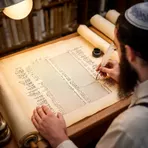
Notes and rules added by Jewish copyists to handwritten copies of the Hebrew Bible
Surface Forms
Etymology
Masorah comes from the Hebrew מסורה, which means 'tradition' or 'handing down'. It was the name given to the notes and rules that scribes passed down about how to read and pronounce the Hebrew Bible, so the Masorah today is the traditional set of notes that helps keep the text correct.