
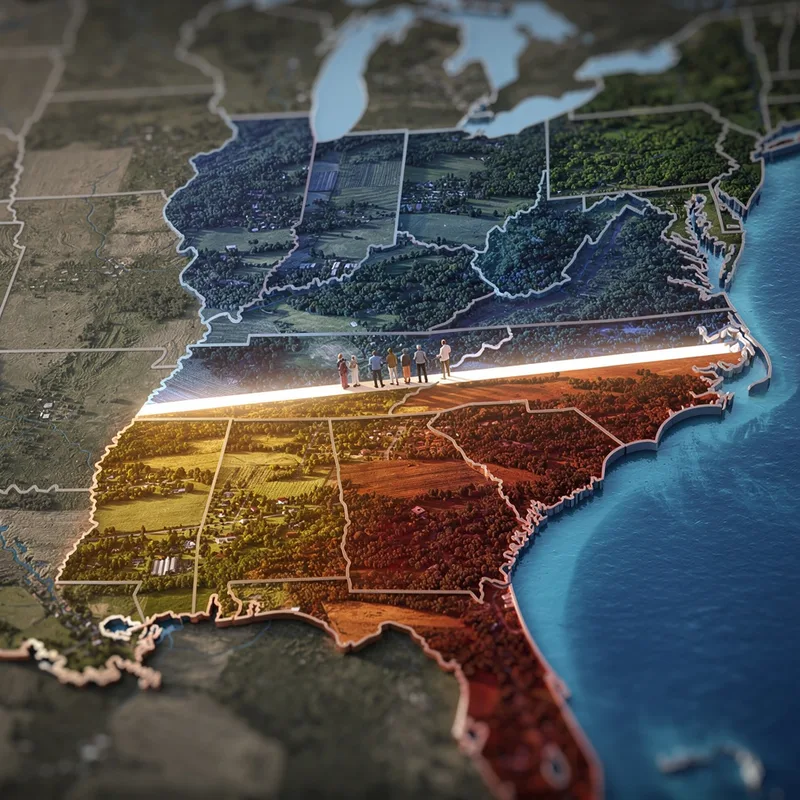
Mason-Dixon line
 1
7.7
1
7.7

- noun
- /ˈmeɪsənˈdɪksən laɪn/
- US
- Many families have traditions that differ based on whether they live above or below the Mason-Dixon line.
- south of the Mason-Dixon line
- north of the Mason-Dixon line
- cross the Mason-Dixon line
Loading YouTube…
Watch on YouTubeBut it's about the people who built who drew the Mason Dixon line, which was Charlie Mason and Jeremiah Dixon.
- But it's about the people who built who drew the Mason Dixon line, which was Charlie Mason and Jeremiah Dixon.
Examples
-
Robert Mentzer is a retired high school physics and astronomy teacher whose home in Wilmington, Delaware, is only a few miles from the Mason-Dixon line.
Academic text (2006) -
First in my family north of the Mason-Dixon line.
-
You all go back to the Mason-Dixon line, sugar.
-
South of the Mason-Dixon line?
Blog text (31) -
Even though my parents only lived sixty miles north of the city, we had crossed an invisible Mason-Dixon line.
Fiction book (1997) -
The first time I ever crossed the Mason-Dixon line was in the fall of 1954 when I headed north to begin my college career at Williams.
Academic text (2016) -
It is understandable that the Republicans decided to hold their convention south of the Mason-Dixon line.
-
Growing up in New York, I often heard stories about life south of the Mason-Dixon line.
-
The debate over state rights and slavery intensified along the Mason-Dixon line before the Civil War.
Synonyms
 37
2.1
37
2.1
A border between two states in the same country
 9
4.1
9
4.1
A line that shows the edge between two places or countries


 1
3.2
1
3.2
An official line that divides two areas in the same country, like New York and New Jersey
Border between Maryland and Pennsylvania that marks an old divide between North and South
Surface Forms
Morphology
Mason-Dixon + line
The element 'line' transparently signals a boundary, so a learner who knows the words could infer this is some kind of dividing line; however 'Mason-Dixon' are proper names with no semantic content for most learners, and the specific historical/geographical sense (Maryland vs. Pennsylvania; symbolic North–South divide) is not derivable from the constituents. Because part of the meaning (a boundary) is transparent but the culturally specific referent and symbolism are not, this is best classified as semi-transparent.
Etymology
Mason-Dixon line comes from two men, Mason and Dixon, who measured and marked the border between colonies in the 1760s. Because that border later showed a clear split between 'North' and 'South', people now use Mason-Dixon line to mean a symbolic 'dividing line' between different regions or ways of life.