
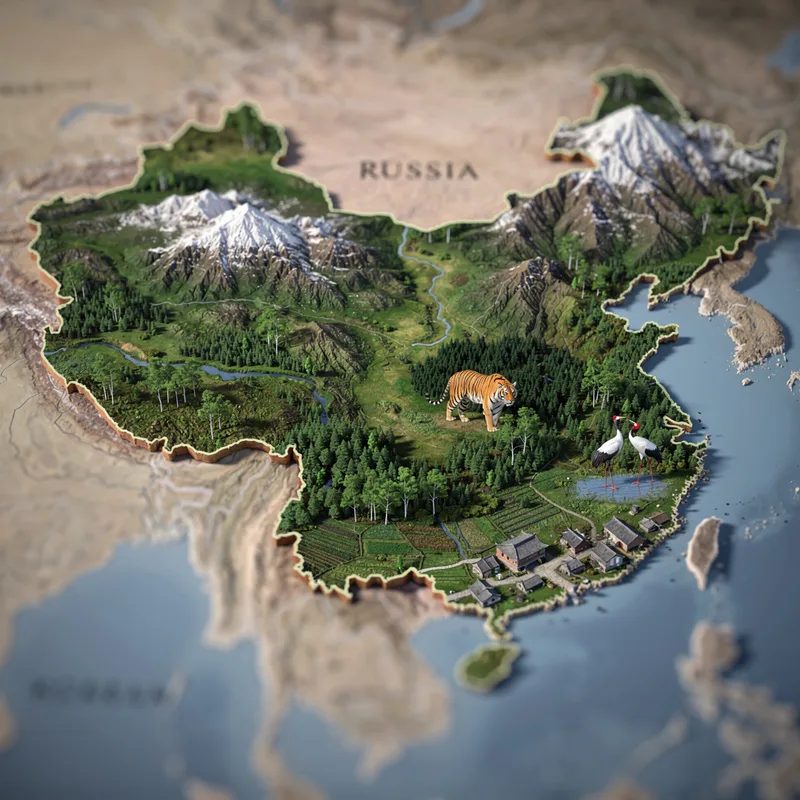
Manchuria
 4
7.3
4
7.3

- proper noun
- /mænˈtʃʊəriə/
- Japan was the first, with her invasion of Manchuria in September 1931.
- Japanese interests in Manchuria
- action in Manchuria
- Manchuria and Korea
Loading YouTube…
Watch on YouTubeAt the moment, Stalin's forces are asset stripping the region, but Manchuria still remains incredibly valuable.
- At the moment, Stalin's forces are asset stripping the region, but Manchuria still remains incredibly valuable.
- Despite his victory, Wu was unable to pursue Zhang into Manchuria.
- But her grandfather was from Manchuria.
- Their ancestors had sailed from the grim island to spread across northern Europe, Siberia and Manchuria.
- It's supposed to be kind of about the Japanese and I suppose the British as well, but in Manchuria.
Examples
-
We attacked Japanese troops in Manchuria and blockaded the island of Japan, thus provoking Pearl Harbor.
Blog text (26) -
The escalating Japanese-Russian rivalry over Manchuria culminated in the Russo-Japanese War of 1904-05.
Academic text (2002) -
At the same time, the Soviet Union took Manchuria and gave it back to China.
Blog text (29) -
The Japanese have virtually taken over Manchuria.
-
In the past 150 years, migration to the northeast, or Manchuria, has also been rapid.
Academic text (1991) -
Manchuria became home to more than one million Japanese, 300,000 of them farming families.
Fiction book (2001) -
Most of them came from Manchuria, and some were over forty years old.
-
The Japanese have virtually taken over Manchuria.
-
In the 1920s, Kim's family relocated to neighboring Manchuria, a Chinese territory, where he joined the growing communist movement.
Compounds

A region in Northeast Asia that used to belong to China and is now part of Russia
Surface Forms
Etymology
Manchuria comes from the name of the Manchu people who lived in that region, and the ending -ia is like in India or Australia, meaning 'land' or 'place'. So Manchuria simply means the 'land of the Manchu', which is why it names the area in northeast China.