
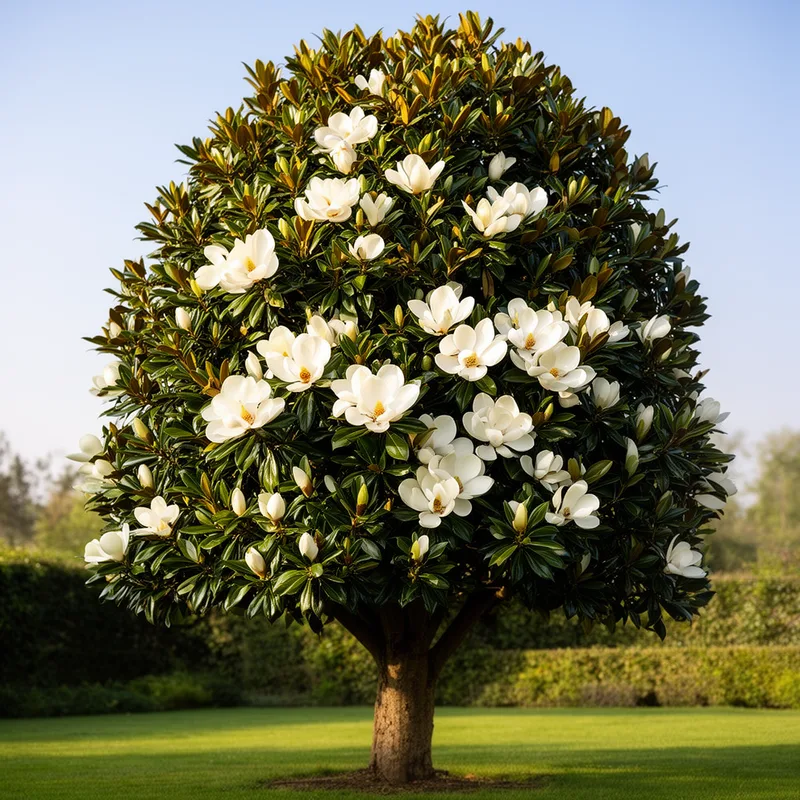
Magnolia grandiflora
- noun
- /mæɡˈnoʊliə ˌɡrændɪˈflɔːrə/
- Specialized
- I love the scent of Magnolia grandiflora flowers.
Examples
-
The Magnolia grandiflora blooms beautifully in the summer.
-
In the Southern states, Magnolia grandiflora is often planted as an ornamental tree in gardens and parks.
-
Botanists admire the Magnolia grandiflora for its lustrous leaves and decorative white blossoms.
-
The Magnolia grandiflora in our backyard blooms every spring with huge, fragrant flowers.
-
In spring, the Magnolia grandiflora produces large, fragrant white flowers that attract bees.
-
The park is filled with Magnolia grandiflora trees, their glossy leaves shimmering in the sunlight.
-
During our garden tour, we marveled at the beauty of the Magnolia grandiflora with its impressive size and aroma.
Synonyms

A tree that keeps its leaves all year with large shiny leaves and big white fragrant flowers
An evergreen tree with large shiny leaves and big white flowers that smell sweet

An evergreen tree with large glossy leaves and big white fragrant flowers

A large tree with shiny leaves and big white flowers that smell sweet
Surface Forms
Morphology
The species name is directly compositional: 'magnolia' (the tree) combined with 'grandiflora' (large-flowered) yields a magnolia with large flowers. Botanical Latin compounds are conventional but the meaning is immediately derivable from the constituents, so a learner who knows both words would understand the MWE.
Etymology
Magnolia grandiflora comes from the name of Pierre Magnol, a French plant scientist, and from Latin words meaning 'large flower'. So Magnolia honors Magnol and grandiflora says the tree has big white flowers, which is why the name fits today.

