

Magna Mater
- proper noun
- Literature
- The cult of Magna Mater was introduced to Rome in the third century BCE.
Examples
-
In ancient art, Magna Mater is often depicted enthroned and surrounded by lions.
-
Priests of the Magna Mater played a key role in Phrygian religious festivals.
-
The worship of Magna Mater was prominent in Phrygia.
-
Did you know that Magna Mater was associated with fertility?
-
In ancient art, Magna Mater is often depicted enthroned and surrounded by lions.
-
Priests of the Magna Mater played a key role in Phrygian religious festivals.
-
The cult of Magna Mater was introduced to Rome in the third century BCE.
Synonyms

 41
9.9
41
9.9

Roman goddess of fertility and good harvests
 2
9.9
2
9.9
An ancient Phrygian goddess worshipped for nature and fertility, often shown with lions
 2
9.9
2
9.9
An ancient mother goddess from what is now Turkey linked to nature, fertility, and mountains
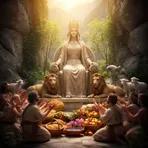
A mother goddess from ancient Phrygia who people worship for life and fertility

An ancient mother goddess from Phrygia who often wears a crown of towers
Surface Forms
Morphology
Magna + mater
The phrase is a direct Latin compound of magna (great) + mater (mother), so its meaning 'Great Mother' (a mother goddess) is compositionally derivable from the parts; even though it is a proper name, the adjective+noun logic is transparent. Therefore a learner who knows the constituent meanings can readily infer the MWE's sense, and the construction parallels similar 'great mother' labels in other languages.
Etymology
Magna Mater comes from Latin words Magna 'great' and Mater 'mother'. It was the name of an ancient mother goddess from Phrygia who later became linked to the Greek Rhea and the Roman Ops, so the name captures the idea of a powerful, protective 'great mother' goddess.