
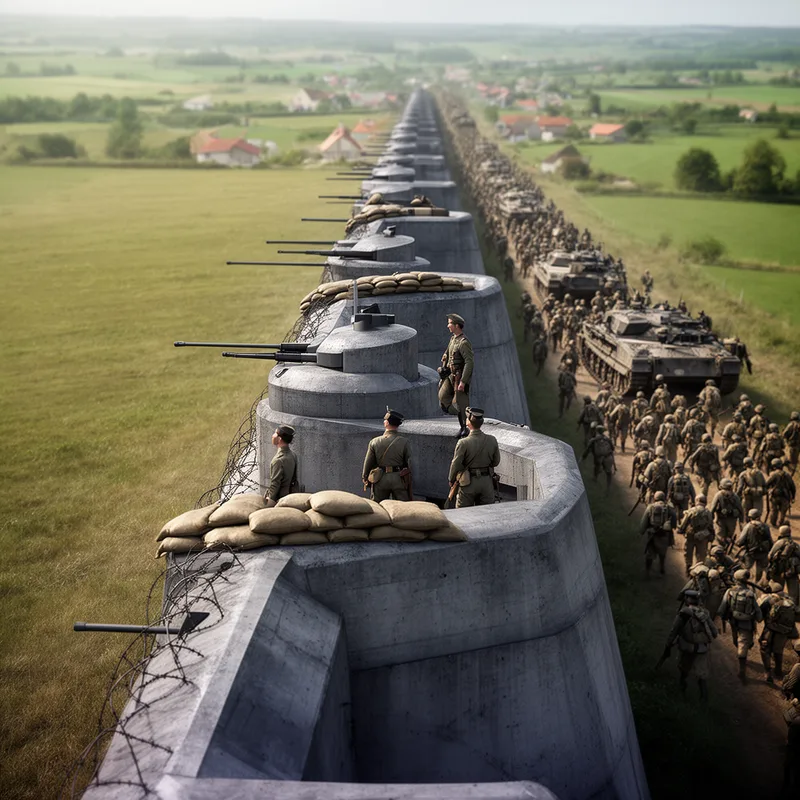
Maginot Line
 1
9.9

- noun
- /ˈmæʒɪnoʊ laɪn/
- France gave priority to its army and to the construction of the defensive Maginot Line over its navy.
Examples
-
Instead of a Maginot Line, the Pentagon is executing its long-standing forward defense strategy, which involves leapfrogging ahead of U.S. borders and waging combat on the turf of U.S. enemies or allies.
Academic text (2004) -
In May 1940, they paid a heavy price for their complacency: Panzer units raced into the lowlands, circumvented the Maginot Line, and conquered France shortly thereafter.
Academic text (2004) -
And the sixth one was about here, 30, 40 miles west of the Maginot Line.
-
Current rules protect academic freedom about as well as the Maginot Line protected the French.
Academic text (1997) -
That's a fort on the Maginot Line.
-
Ask any Frenchman about the vast sums of money wasted on their Maginot Line before World War II.
Blog text (11) -
In the 1930s, the Maginot Line, erected to protect France against a German invasion, had just this effect on French leaders, with terrible consequences for their nation.
Academic text (2001) -
The Maginot Line failed not because it was poorly designed or implemented, but because the Germans recognized precisely how formidable a defense it was and devised a strategy for going around it.
Academic text (2001) -
They activated their reserves and reinforced the Maginot Line, defenses of mounted cannons stretching for 250 miles along the Franco-German border.
Academic text (2004) -
After World War I, the French constructed the Maginot Line to protect themselves from a German attack.
Synonyms
 7
3.3
A wall or barrier that protects against attack
Antonyms


Surface Forms
Morphology
Maginot + line
The word 'line' signals a fortified defensive position, so a learner who knows that meaning can infer this refers to a named defensive fortification; however 'Maginot' is a proper name with no lexical meaning for learners to decode. The historical specifics and the extended figurative sense (a false sense of security) are not derivable from the parts, making the expression only partially predictable.
Etymology
Maginot Line comes from a long row of forts France built along its border before World War II; the forts looked very strong but the enemy simply went around them. So the name Maginot Line now means a 'defense' that gives a 'false sense of security'.