
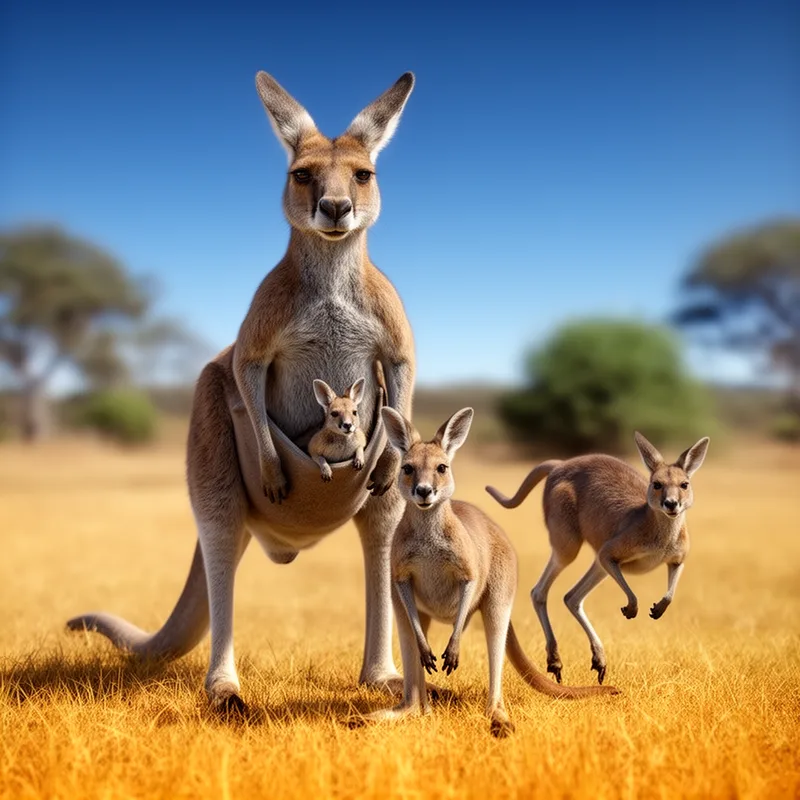
Macropodidae


 1
9.9
- noun
- /ˌmækroʊˈpɒdɪdi/
- Specialized
- All members of the Macropodidae possess powerful hind legs and long tails.
Examples
-
Scientists study Macropodidae to understand the evolution of large marsupials in Australia.
-
The Macropodidae family includes animals adapted for hopping locomotion, like kangaroos and wallabies.
-
Look at that Macropodidae hopping across the field!
-
The Macropodidae family includes kangaroos and wallabies.
-
The Macropodidae family includes various marsupials like kangaroos and wallabies, known for their strong hind legs.
-
In Australia, animals from the Macropodidae family are often seen hopping across the open fields.
-
Researchers study the Macropodidae to understand their unique adaptations for survival in the wild.
Surface Forms
Morphology
Macropodidae = macropod (semi-transparent) = macro + pod + idae
The family name is built from the zoological base 'macropod' plus the taxonomic suffix '-idae', but the specialized scientific convention is not fully transparent to an average learner.
Etymology
Macropodidae comes from Greek parts macro- meaning 'large' and pod meaning 'foot'. So it literally says 'large-foot family', which fits kangaroos and wallabies that have big feet for hopping.