
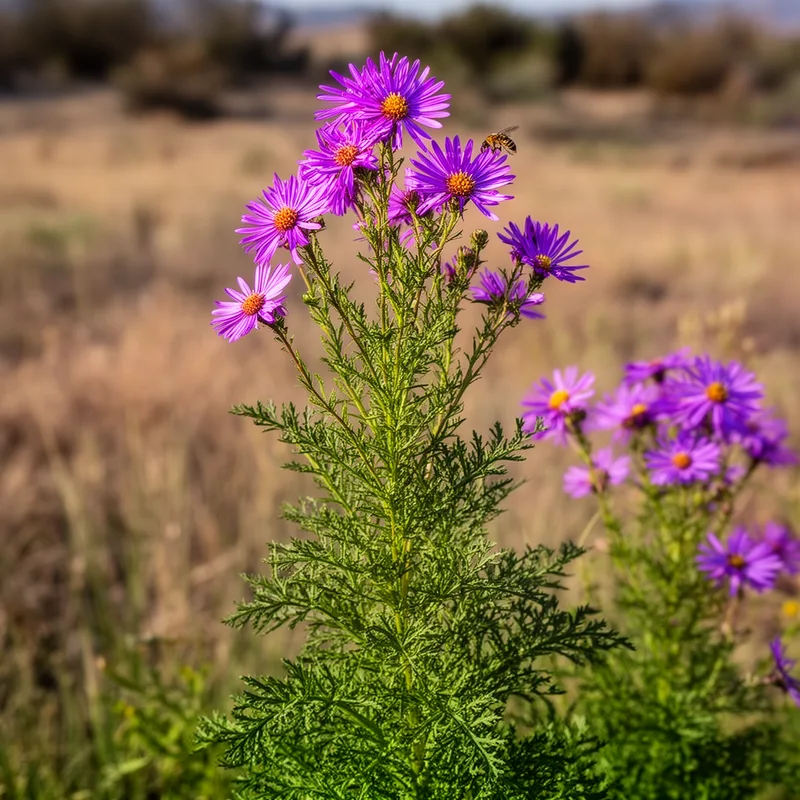
Machaeranthera tanacetifolia
- noun
- Specialized
 :
Machaeranthera tanacetifolia
:
Machaeranthera tanacetifolia
- The field was dotted with the bright purple flowers of Machaeranthera tanacetifolia in late summer.
Examples
-
In the meadows of Texas, the vibrant purple flowers of Machaeranthera tanacetifolia attract numerous pollinators every summer.
-
Wildlife in the area depend on Machaeranthera tanacetifolia as a source of nectar.
-
Researchers studied how Machaeranthera tanacetifolia adapted to the arid climate of the region.
-
The Machaeranthera tanacetifolia blooms beautifully in the summer.
-
Look at the Machaeranthera tanacetifolia!
-
The unique fernlike leaves of Machaeranthera tanacetifolia make it a standout species in wildflower gardens.
-
During a hike in Alberta, we encountered fields filled with Machaeranthera tanacetifolia, showcasing their stunning purple rays.
Synonyms

A wild flower with narrow bright purple petals and fernlike leaves that grows from Alberta to Mexico

A wild North American flower with leaves like a fern and narrow purple petals
Surface Forms
Morphology
Machaeranthera + tanacetifolia
This is a Latin botanical binomial rather than an English phrase, and its parts are specialized morphemes not known to an average B1 learner (one element is even listed as not found in the dictionary). Although specialist knowledge of Latin roots (tanacet- + -folia) could hint at a ‘tansy‑leaved’ wildflower, that is domain‑specific and not predictable from everyday English vocabulary. Therefore the expression’s meaning is not transparently derivable by a typical B1 learner.
Etymology
Machaeranthera tanacetifolia may come from Greek words: machaera meaning 'knife' (for its very narrow, blade-like purple petals) and tanacetifolia meaning 'tansy-like leaves' (for its fern-like foliage). So the name gives a simple picture — a wild aster with knife-thin purple rays and leaves like a tansy — which helps you remember this plant.

