
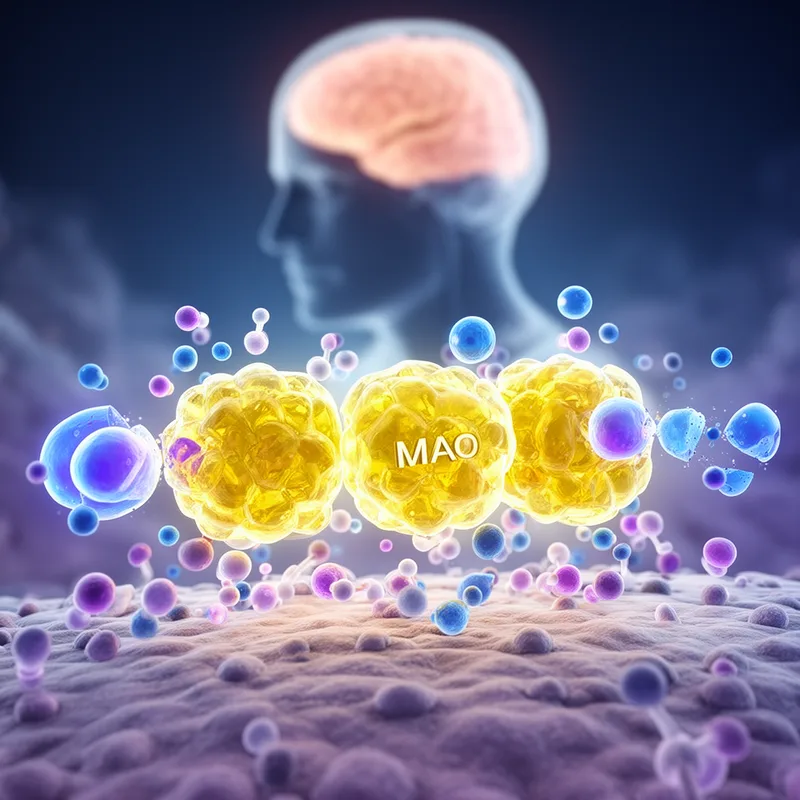
MAO
- noun
- /ˌɛm.eɪˈoʊ/
- Specialized
- The monoamine (MAO) inhibitor class of antidepressants, again on the surface level, may offer another approach to the link between depression and PD.
- MAO inhibitors
Loading YouTube…
Watch on YouTubeThe SSRI worked by distinct mechanisms from the tricyclic antidepressants in the Mao inhibitors.
- The SSRI worked by distinct mechanisms from the tricyclic antidepressants in the Mao inhibitors.
- One of the plants contains DMT which is the psychedelic and then another can the other plant contains an Mao inhibitor.
Examples
-
MAO inhibitors, haloperidol, and fluoxetine.
Academic text (2007) -
The enzyme MAO plays a crucial role in the breakdown of neurotransmitters in the brain.
-
The SSRI worked by distinct mechanisms from the tricyclic antidepressants in the Mao inhibitors.
-
And harmine is a strong Mao inhibitor, but it also stimulates neurogenesis which is nerve growth and these are recent findings.
-
Additive effects with other sympathomimetics, MAO inhibitors, phenothiazines, and tricyclic antidepressants.
Academic text (2007) -
Research indicates that low levels of MAO can lead to increased impulsive behavior.
-
Many studies focus on the function of MAO in regulating mood by influencing serotonin levels.
Synonyms

A substance in the body that breaks down brain chemicals like serotonin and dopamine
Compounds


 1
8.0
1
8.0
A short, light jacket with a high stand-up collar that leaders wore in China during Mao Zedong's time
Surface Forms
Morphology
MAO = monoamine oxidase (opaque) = M + A + O
If the learner knows the technical term 'monoamine oxidase', forming the initialism 'MAO' from its initial letters is straightforward. [Postprocessing: changed transparency from 'transparent' to 'semi-transparent' for abbreviation]
Etymology
MAO is short for monoamine oxidase. The part mono- means 'one', amine names a kind of chemical, and oxidase is about using 'oxygen', like 'rust', to change something, so the name tells you that MAO 'breaks down' certain small brain chemicals and can affect mood.