
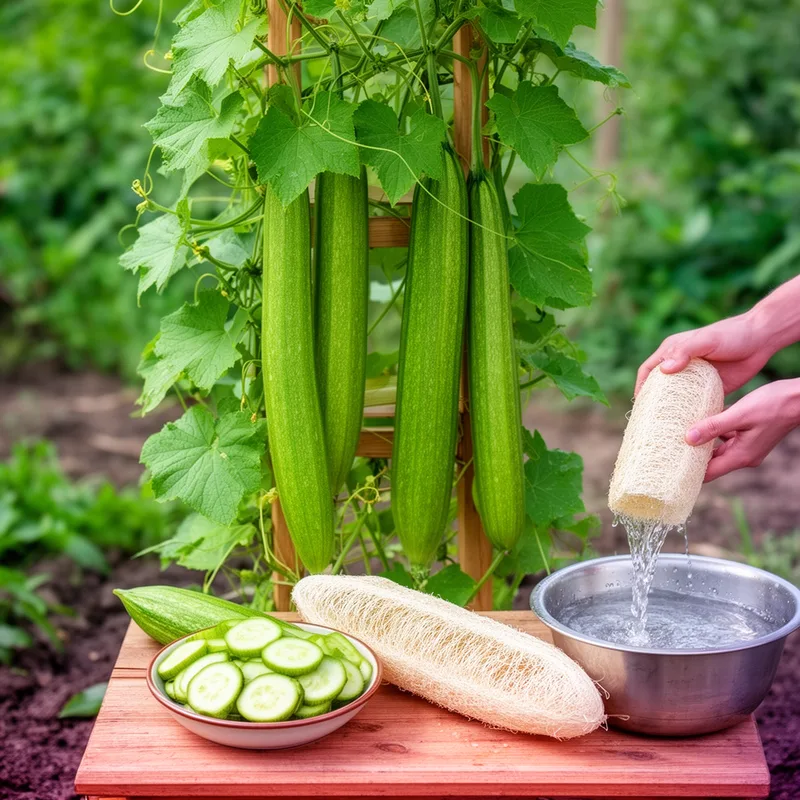
Luffa cylindrica
- noun
- /ˈlʌfə sɪˈlɪndrɪkə/
- Specialized
- The fruit of the Luffa cylindrica is often used as a natural scrubbing sponge in kitchens and bathrooms.
Examples
-
Young Luffa cylindrica gourds are edible and commonly used in Asian cuisines.
-
Gardeners in warm climates can easily grow Luffa cylindrica on trellises for both food and utility purposes.
-
The Luffa cylindrica plant grows well in warm climates.
-
Have you tried cooking with Luffa cylindrica?
-
Gardeners in warm climates can easily grow Luffa cylindrica on trellises to produce both edible fruit and natural sponges.
-
The fruit of Luffa cylindrica is often harvested when young for cooking and becomes a popular natural sponge when mature.
-
In Asian cuisines, young Luffa cylindrica is used as a vegetable in various dishes.
Synonyms

 2
6.4
2
6.4

A tropical climbing plant that produces long, cucumber-like fruit with a stringy inside

A climbing tropical plant whose fruit becomes a dry fibrous sponge and whose young fruit is eaten

A plant fruit used as a natural bath sponge, like a loofah

A group of vines from warm places that make a stringy fruit used as a natural scrub sponge
A long green vegetable with ridges that people eat when young and use as a natural sponge after it dries
Surface Forms
Morphology
luffa + cylindrica
The binomial name denotes a luffa species characterized by a cylindrical form, so the meaning is directly compositional: luffa + (cylindrical). Although 'cylindrica' is a Latin epithet not listed in the provided dictionary entry, it is transparently related to English 'cylindrical' (and cognate across many languages), so a learner who knows both constituents can infer the meaning.
Etymology
Luffa cylindrica may come from an old Arabic word for 'sponge' because when the gourd dries its inside becomes a stringy sponge used to scrub. The second word, cylindrica, points to the long, tube-like shape of the fruit, so the name helps you remember that this gourd becomes a natural 'sponge'.