
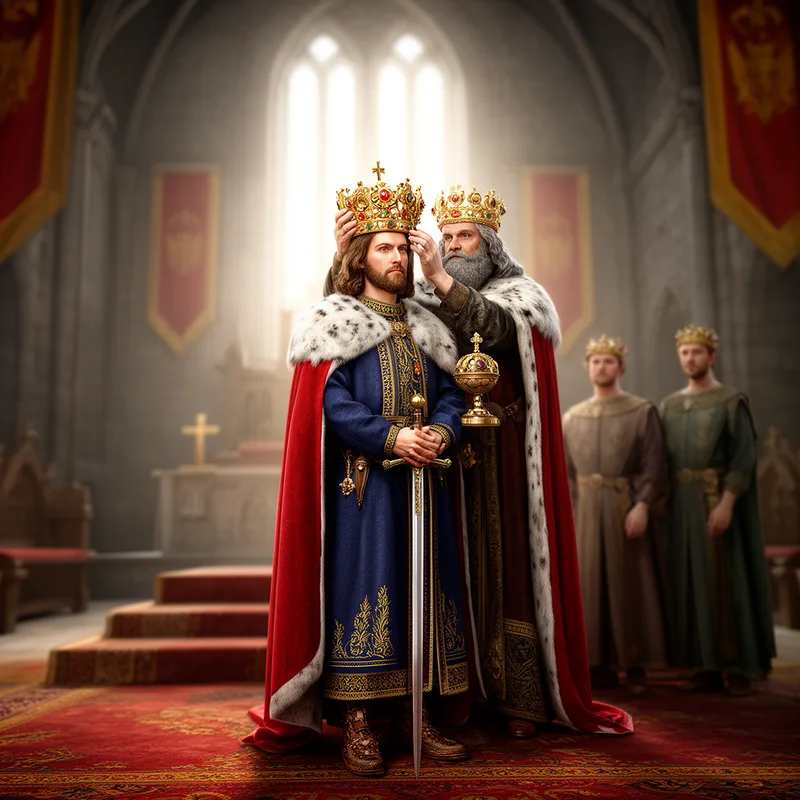
Louis the Pious


 1
9.9
- proper noun
- Louis the Pious succeeded Charlemagne as Holy Roman Emperor in 814.
Examples
-
The reign of Louis the Pious was marked by religious reforms and internal strife.
-
Many historians study Louis the Pious for his role in the division of the Carolingian Empire.
-
Louis the Pious was a king.
-
What did Louis the Pious achieve?
-
Louis the Pious became Holy Roman Emperor after the death of his father, Charlemagne, in 814.
-
The efforts of Louis the Pious to maintain the unity of the Carolingian Empire were significant.
-
Louis the Pious is remembered for his devoutness and his promotion of religious reforms.
Surface Forms
Morphology
Louis + the + pious
The epithet 'the Pious' directly combines the name Louis with the adjective 'pious', so a learner who knows the constituents will infer it refers to a man named Louis who is devout. This 'Name the Adjective' construction is cross-linguistically common (e.g. 'Alexander the Great'), making the basic meaning predictable even if historical details remain unknown.
Etymology
Louis the Pious is a nickname that shows he was very religious as a ruler. He prayed, fasted and supported the Church, so people called him 'the pious' and that label stuck to him.