
Louis de Broglie


 1
9.9
- proper noun
- /luːi də broʊɡli/
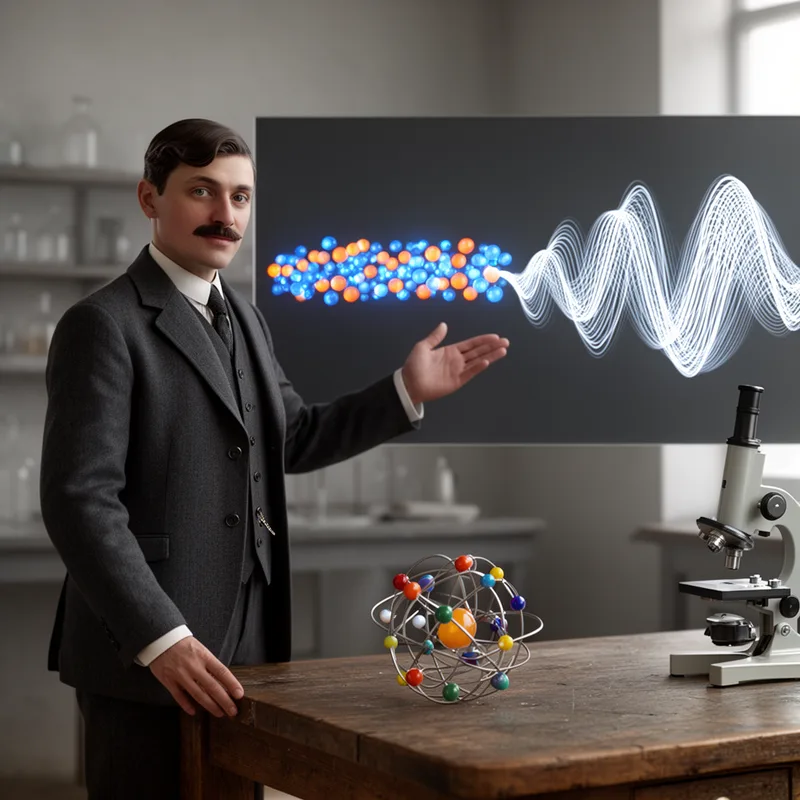
- Louis de Broglie proposed that particles have wave-like properties.
Examples
-
The groundbreaking theory developed by Louis de Broglie changed our understanding of particles at the atomic scale.
-
Modern quantum mechanics owes much to the early work of Louis de Broglie.
-
Einstein praised the innovative ideas of Louis de Broglie regarding wave-particle duality.
-
Did Louis de Broglie win a Nobel Prize in Physics?
-
The groundbreaking theory developed by Louis de Broglie changed our understanding of particles at the atomic scale.
-
Modern quantum mechanics owes much to the early work of Louis de Broglie.
-
Einstein praised the innovative ideas of Louis de Broglie regarding wave-particle duality.
Surface Forms
Morphology
Louis + de + Broglie
This is a proper name referring to a specific person; knowing the constituent items ('Louis', the French particle 'de', and the surname 'Broglie') does not allow a B1 learner to infer the referent is a French physicist or his theory. Proper nouns are referential rather than compositional and are cross-linguistically unpredictable, so the meaning cannot be derived from the parts.
Etymology
Louis de Broglie was a French scientist who imagined tiny particles, like electrons, behaving like waves, similar to ripples in a pond. That's why his name is linked to the idea of 'wave-particle duality', meaning matter can act as both a wave and a particle.