
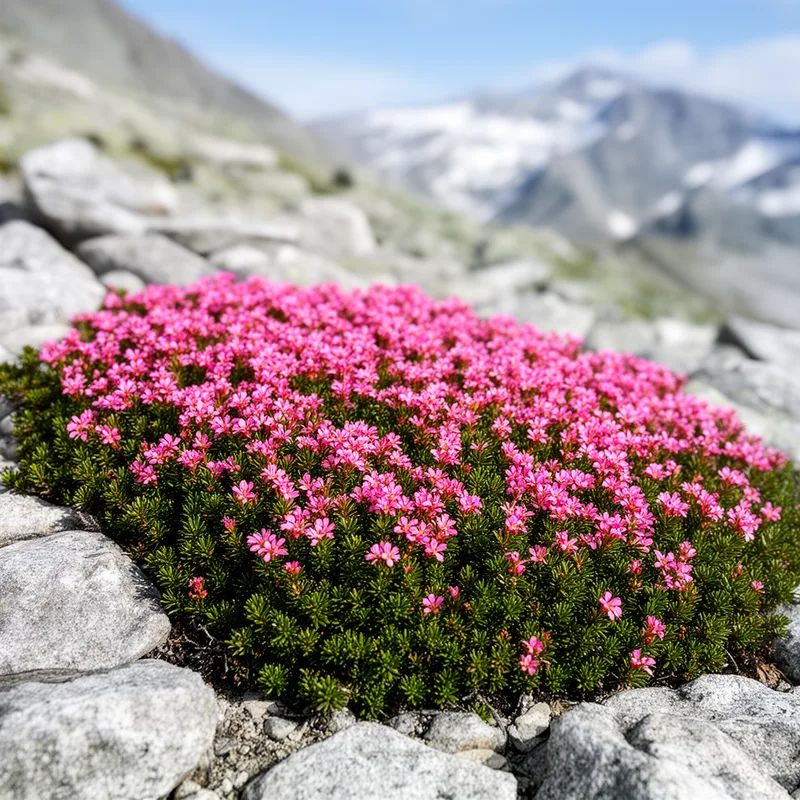
Loiseleuria procumbens
- noun
- Specialized
 :
Loiseleuria procumbens
:
Loiseleuria procumbens
- The delicate pink flowers of the Loiseleuria procumbens can be seen carpeting alpine slopes in late spring.
Examples
-
Gardeners admire Loiseleuria procumbens for its ability to thrive in rocky, high-altitude environments.
-
Researchers studied the habitat preferences of Loiseleuria procumbens in the northern mountains.
-
The Loiseleuria procumbens blooms beautifully in the summer.
-
Have you ever seen a Loiseleuria procumbens in the wild?
-
Gardeners admire Loiseleuria procumbens for its ability to thrive in rocky, high-altitude environments.
-
The delicate pink flowers of the Loiseleuria procumbens can be seen carpeting alpine slopes in late spring.
-
Researchers studied the habitat preferences of Loiseleuria procumbens in the northern mountains.
Synonyms

A low evergreen shrub that forms mats on high mountain rocks and has pink flowers

A low evergreen shrub that spreads on mountain slopes and makes pink flowers
Surface Forms
Morphology
Loiseleuria + procumbens
This is a Latin binomial (genus + specific epithet) whose meaning is compositionally descriptive: if a learner knew 'Loiseleuria' as a small shrub and understood 'procumbens' as 'lying down/creeping', they could infer a creeping/ground‑hugging shrub. However, 'procumbens' is a non‑English, technical epithet and the form is specialized; therefore the meaning is only partially transparent to a B1 learner and often requires botanical or Latin knowledge.
Etymology
Loiseleuria procumbens is named after a French botanist, Loiseleur, and the Latin word procumbens means 'lying down'. Because the plant grows low and spreads over rocks in the mountains, the name helps you remember it is a creeping 'alpine azalea'.

