
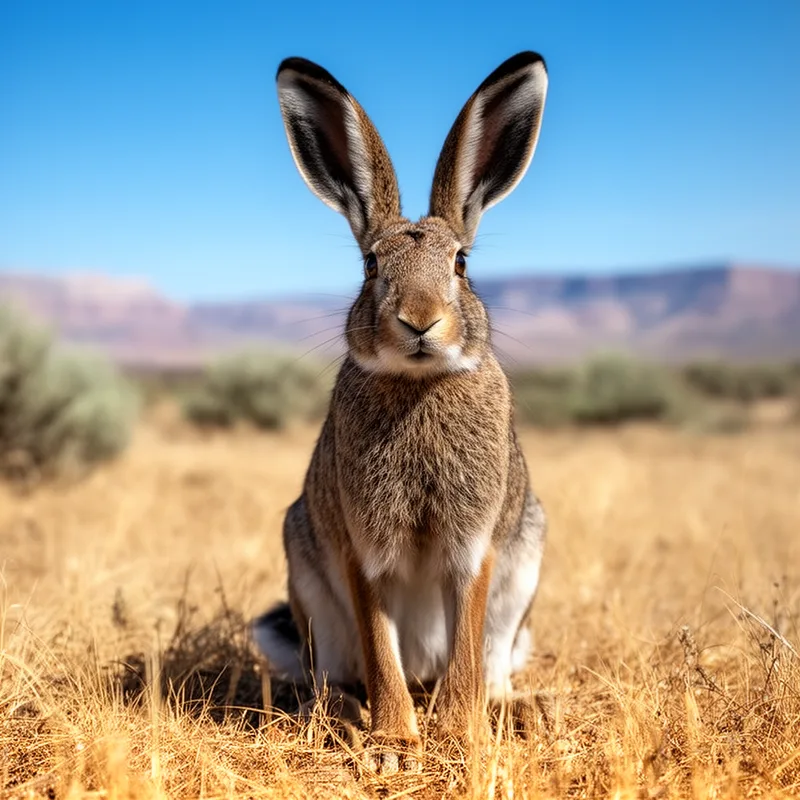
Lepus californicus
- noun
- /ˈlɛpəs ˌkælɪˈfɔrnɪkəs/
- Specialized
 :
Lepus californicus
:
Lepus californicus
- The Lepus californicus scurried across the grassland, its black-tipped ears alert for danger.
Examples
-
The Lepus californicus can often be seen bounding through the deserts of the American Southwest.
-
With its striking ears and speed, Lepus californicus easily escapes most predators in its natural habitat.
-
Researchers tracked the movements of Lepus californicus during a population study in Nevada.
-
The Lepus californicus is known for its impressive speed.
-
I spotted a Lepus californicus in the field yesterday.
-
During my hike, I was fortunate to see a Lepus californicus darting through the open fields.
-
As the sun set, a Lepus californicus emerged from the brush, showcasing its distinctive black-streaked tail.
Synonyms

A large wild hare with long black-tipped ears and a black streak on its tail
Surface Forms
Morphology
Lepus + californicus
The name is compositionally built from the Latin genus 'Lepus' (a hare) plus the specific epithet 'californicus' (meaning 'from California'), so a learner who knows both parts can infer it denotes a California hare species. However, because these are Latin taxonomic terms rather than everyday English words and understanding requires knowledge of scientific naming conventions, the transparency is limited for an average B1 learner.
Etymology
Lepus californicus comes from Latin words: Lepus means 'hare' and californicus means 'from California'. That's why the name means 'hare from California' and helps you remember it is a jackrabbit found in the western United States.

