

Leptoptilus crumeniferus
- noun
- Specialized
- The Leptoptilus crumeniferus is often seen scavenging near wetlands and garbage dumps in sub-Saharan Africa.
Examples
-
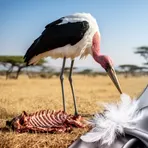
Unlike other storks, Leptoptilus crumeniferus is notable for its consumption of carrion as its primary food source.
-
Feathers from the Leptoptilus crumeniferus were once prized for decorating hats and clothing.
-
The Leptoptilus crumeniferus is often seen near carcasses.
-
Have you ever spotted a Leptoptilus crumeniferus in the wild?
-
The Leptoptilus crumeniferus is known for its striking black-and-white plumage and scavenging behavior.
-
While walking through the savanna, I spotted a Leptoptilus crumeniferus feeding on a dead animal.
-
The feathers of the Leptoptilus crumeniferus are soft and often used in traditional African attire.
Synonyms

 1
9.9
1
9.9

Large African stork that eats dead animals and has black and white feathers

 1
9.6
1
9.6
A large African bird with black and white feathers that eats dead animals and has soft feathers for trims

A large African stork with black and white feathers that often eats dead animals
Surface Forms
Morphology
Leptoptilus + crumeniferus
This is a Latin scientific binomial (a taxonomic name) rather than a compositional English phrase; the specific epithet 'crumeniferus' is not attested in the learner dictionary and 'Leptoptilus' functions as a proper genus label. A B1 learner who knows the listed constituents would not be able to derive the descriptive meaning (a large African stork that feeds on carrion) from these elements, so prior specialist or lexical knowledge is required.
Etymology
Leptoptilus crumeniferus is a very large African stork that often eats dead animals and has soft underwing feathers people once used to decorate hats and clothes. So, the name brings to mind a big scavenging bird and its decorative 'feathers'.