
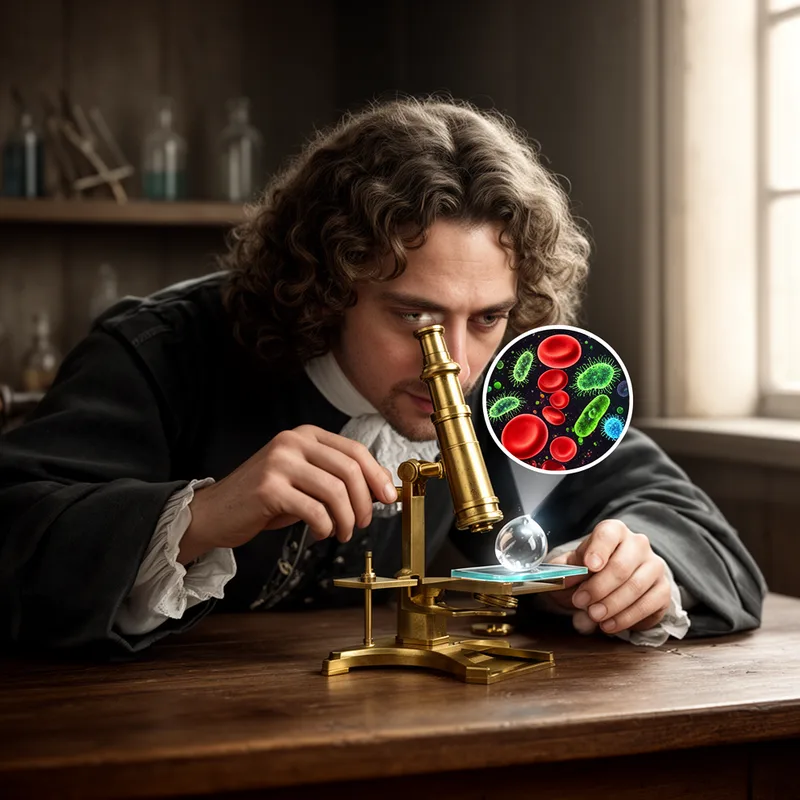
Leeuwenhoek
 1
9.9

- proper noun
- /ˈluːənhʊk/
- The single-lens optical microscope dates back to the mid-15th century, and Antonie van Leeuwenhoek discovered microorganisms with one around 1674—the birth year of microbiology.
- Antonie van Leeuwenhoek
Examples
-
Van Leeuwenhoek is credited with the discovery of microscopic organisms that revolutionized biology.
-
I traded him in for an adventurer, Antoni Van Leeuwenhoek, the father of microbiology.
Fiction book (1994) -
This is the greatest discovery since van Leeuwenhoek first looked through a microscope and saw an amoeba.
-
He had stumbled upon a note from the pioneering Dutch microscopist Leeuwenhoek.
Academic text (2010) -
"I have macerated a little crocus in brandy," Leeuwenhoek had informed Britain's Royal Society, explaining how he prepared some thinly sliced muscle tissues.
Academic text (2010) -
In the 17th century, Leeuwenhoek used simple microscopes to observe and describe bacteria for the first time.
-
Antonie van Leeuwenhoek is often referred to as the father of microbiology due to his groundbreaking work with microscopes.
Synonyms

 1
9.2
A Dutch scientist who first used small microscopes to see tiny living things like bacteria
A Dutch scientist who used small microscopes to see tiny living things like bacteria, sperm cells, and blood cells
A scientist from the Netherlands who first looked at tiny living things like cells and bacteria with a microscope
Surface Forms
Etymology
Leeuwenhoek comes from Dutch parts leeuwen 'lions' and hoek 'corner', so the name literally means 'lion's corner'. A helpful image is a brave lion peering into a corner to find hidden things, which fits how Antonie van Leeuwenhoek looked into tiny worlds with his microscope and discovered tiny living things.