
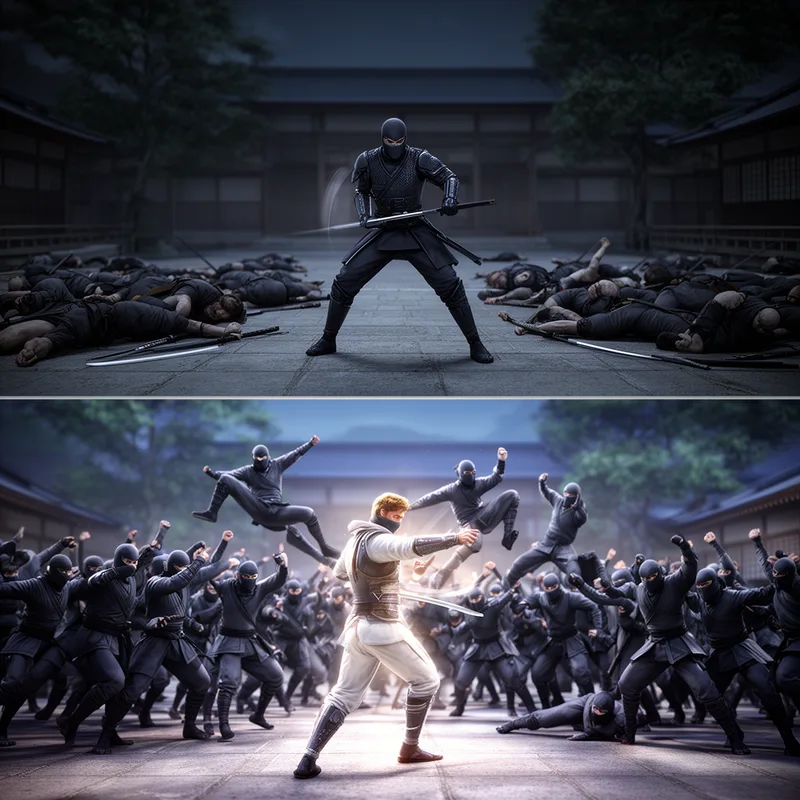
Law of Conservation of Ninjutsu
- noun
- /lɔː ʌv kənˌsɜːrˈveɪʃən ʌv nɪnˈdʒuːtsu/
- Jargon
- The Law of Conservation of Ninjutsu suggests that a single ninja is more powerful than a whole clan.
Examples
-
The Law of Conservation of Ninjutsu explains why a crowd of ninjas is always easily defeated by the hero.
-
Fans often refer to the Law of Conservation of Ninjutsu when groups of henchmen fail in anime.
-
During the discussion, he mentioned the Law of Conservation of Ninjutsu to joke about overpowered solo fighters.
-
In his latest video, Ben explained the Law of Conservation of Ninjutsu humorously.
-
In many action movies, the Law of Conservation of Ninjutsu demonstrates that one skilled ninja can defeat an army of lesser opponents.
-
The Law of Conservation of Ninjutsu humorously illustrates how a small number of ninjas can outsmart a larger group in anime.
-
Whenever a team of ninjas appears in a scene, fans jokingly reference the Law of Conservation of Ninjutsu to highlight their gradual ineffectiveness.
Surface Forms
Morphology
law + of + conservation + of + ninjutsu
The phrase is compositionally clear: a learner who knows 'law', 'conservation' and 'ninjutsu' can infer it denotes a (playful) rule about ninjutsu being 'conserved' or governed by some principle. However, the specific humorous meaning — that individual ninjas become weaker in groups — depends on cultural/fandom parody of scientific 'conservation' laws and cannot be fully predicted from the parts alone, so it is only partially transparent.
Etymology
Law of Conservation of Ninjutsu is a playful idea that uses the sound of a science 'law' to make a joke. It imagines a ninja's skill, ninjutsu, being shared so one ninja keeps most power while many ninjas each have less, and that's why fans say a solo fighter is 'strong alone' and a crowd is 'weak in a group'.

