
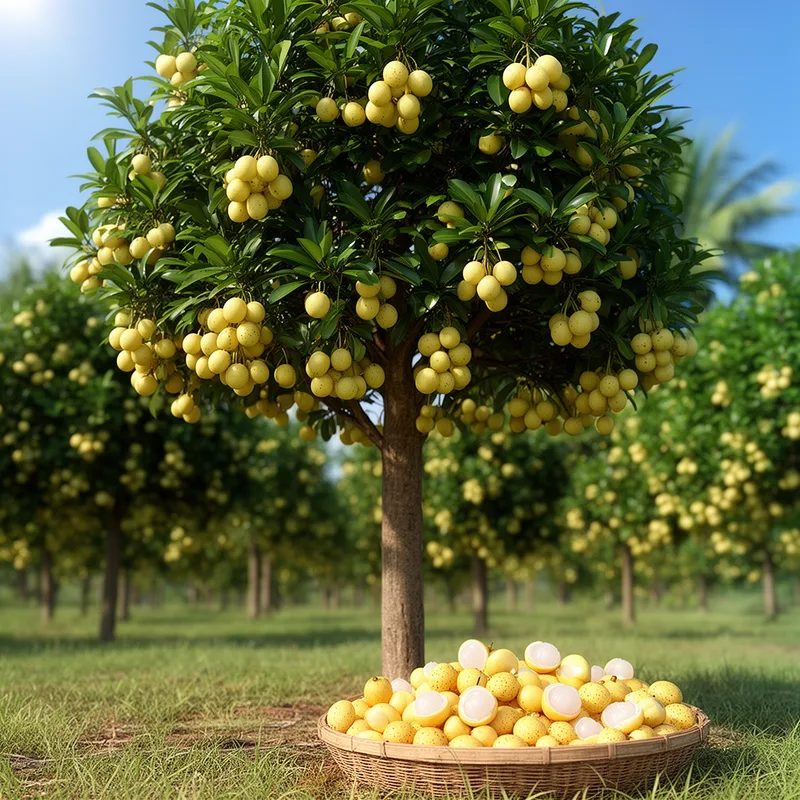
Lansium domesticum
- noun
- Specialized
- The Lansium domesticum tree is widely cultivated for its sweet and tangy fruit.
Examples
-
The Lansium domesticum tree thrives in humid tropical climates.
-
I tasted Lansium domesticum for the first time during my trip to Malaysia.
-
Farmers in Indonesia export large quantities of Lansium domesticum every year.
-
Many people enjoy the sweet taste of Lansium domesticum fruits.
-
Many people enjoy the sweet taste of Lansium domesticum fruits.
-
I tasted Lansium domesticum for the first time during my trip to Malaysia.
-
The Lansium domesticum tree is widely cultivated for its sweet and tangy fruit.
Synonyms
A tropical tree that produces small yellow fruits with sweet, slightly sour flesh

A small round fruit with tart yellow flesh like a berry
A group of tropical Asian trees that produce edible fruit called langsat
Surface Forms
Morphology
Lansium + domesticum
This is a Latin binomial combining the genus name 'Lansium' (a genus of tropical trees with edible fruits) with a specific epithet 'domesticum', so a learner who knows both parts can infer it denotes a particular species of Lansium (i.e., a type of tropical tree). However, the detailed senses in the dictionary definition (yellow berries called langsat) are factual botanical information not predictable from the constituents alone, and recognizing the taxonomic function requires domain knowledge, so the transparency is only partial.
Etymology
Lansium domesticum probably comes from the local word 'langsat' for the fruit and the Latin word domesticum meaning 'of the home'. So the name gives a clear image: a common tree people grow near their homes that bears the sweet 'langsat' berries, and that is why it names this edible tree today.

