

Lanius ludovicianus excubitorides
- noun
- Specialized
- The gray and white plumage distinguishes the Lanius ludovicianus excubitorides from other shrikes in the region.
Examples
-
The Lanius ludovicianus excubitorides is known for impaling its prey on thorns or barbed wire.
-
Birdwatchers spotted a Lanius ludovicianus excubitorides perched on a fence in New Mexico.
-
The Lanius ludovicianus excubitorides can often be spotted in open fields.
-
Have you ever seen a Lanius ludovicianus excubitorides in the wild?
-
Birdwatchers observed a Lanius ludovicianus excubitorides hunting in a nearby field in Arizona.
-
The Lanius ludovicianus excubitorides has striking grey upperparts that help it blend into its surroundings.
-
In late spring, the Lanius ludovicianus excubitorides can be heard singing from the treetops.
Synonyms
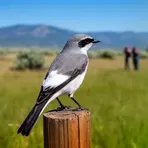
A small grey and white bird with a white patch on its rump found in western North America
Surface Forms
Morphology
Lanius + ludovicianus + excubitorides
This is a scientific Latin trinomial (taxonomic name). Even if a learner recognized 'Lanius' as a genus of shrikes, the epithets 'ludovicianus' and 'excubitorides' are opaque Latin forms not predictable from everyday English vocabulary, so the specific subspecies sense cannot be derived. Taxonomic names function as arbitrary labels rather than compositional phrases, making this unintelligible to a B1 learner from the parts alone.
Etymology
Lanius ludovicianus excubitorides may come from the Latin word Lanius, meaning 'butcher', because this shrike kills and often sticks its prey on thorns or barbed wire like a butcher hanging meat. The rest of the name (ludovicianus, excubitorides) names the local type, so the full name helps you remember the bird's 'butcher' habit.

