
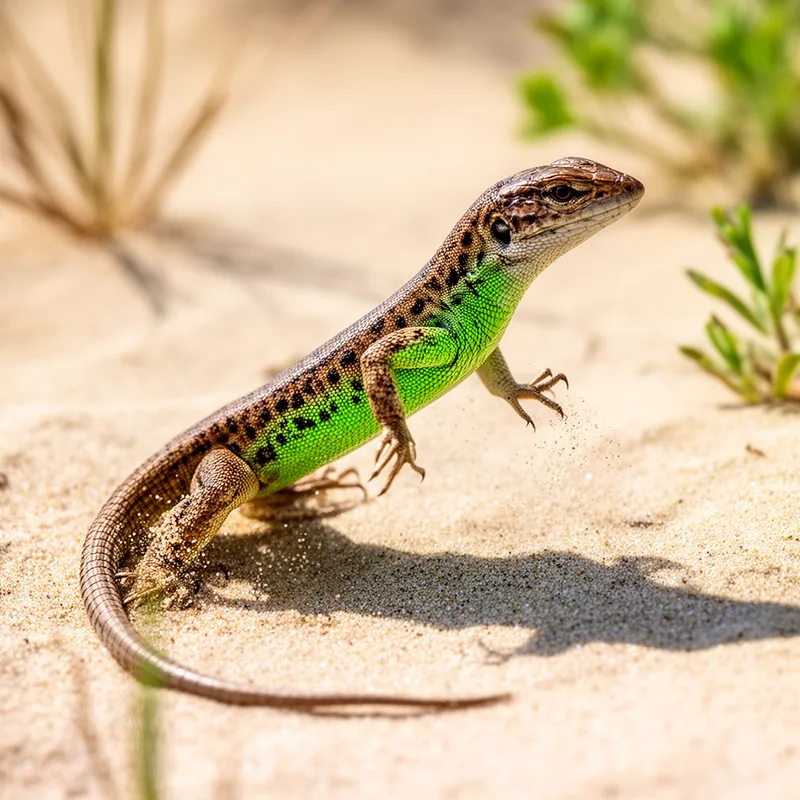
Lacerta agilis
- noun
- Specialized
- The Lacerta agilis is often seen basking in the sun on sandy banks throughout Europe.
Examples
-
The Lacerta agilis darts quickly across the path, demonstrating its agile movements.
-
In spring, you can often observe the Lacerta agilis hunting for insects in grassy areas.
-
Scientists study the habitat range of Lacerta agilis to understand environmental changes in the region.
-
The distinctive green coloration helps Lacerta agilis blend into its surroundings.
-
The Lacerta agilis is often seen basking in the sun.
-
Have you ever spotted a Lacerta agilis in the wild?
-
The vibrant colors of the Lacerta agilis help it avoid predators in its natural habitat.
Synonyms



 1
9.9
A group of lizards found in Europe and Asia

A lizard that lives on land and is active during the day

A small ground lizard found in warm places like Europe and Africa
Surface Forms
Morphology
Lacerta + agilis
This binomial name is compositionally built from the genus name Lacerta (a lizard) plus the Latin adjective agilis (meaning 'agile' / cognate with English 'agile'), so the sense 'agile lizard' or a lizard species characterized by agility is directly derivable. Binomial nomenclature routinely uses descriptive Latin adjectives and the root is cognate across many languages, making the meaning predictable for learners who know the constituent words.
Etymology
Lacerta agilis comes from Latin words that describe the animal: lacerta means 'lizard' and agilis means 'quick'. So the name gives a clear picture of a fast-moving lizard and explains why it refers to this common species.