
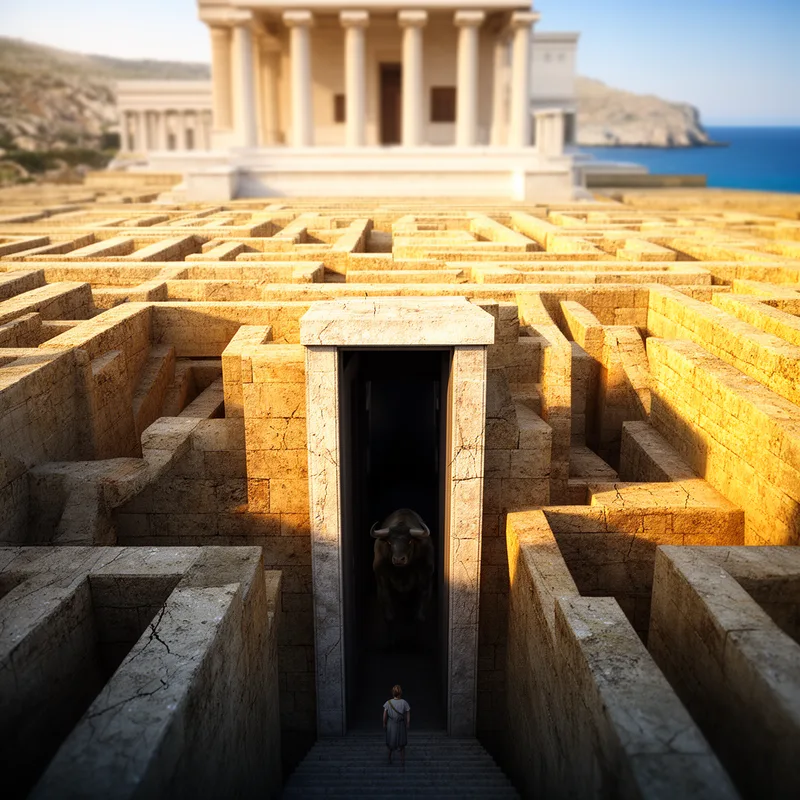
Labyrinth of Minos
- noun
- /ˈlæbərɪnθ əv ˈmaɪnəs/
- Literature
- The legend says that Theseus navigated the Labyrinth of Minos to slay the Minotaur.
Examples
-
The Labyrinth of Minos was designed to trap the Minotaur.
-
Many adventurers sought to escape the Labyrinth of Minos, but few succeeded.
-
Archaeologists have long debated the real-world inspiration for the Labyrinth of Minos.
-
Many stories revolve around the Labyrinth of Minos and its mysteries.
-
According to the myth, Theseus bravely entered the Labyrinth of Minos to confront the powerful Minotaur.
-
In ancient times, the Labyrinth of Minos was thought to be an inescapable maze filled with danger.
-
The Labyrinth of Minos represents the complex nature of challenges we face in life.
Synonyms

 54
2.5
54
2.5

A group of connected paths made as a puzzle to find the exit
 31
7.4
31
7.4
A complicated set of connected paths that is hard to find your way through
Surface Forms
Morphology
The phrase is a literal possessive combination: 'labyrinth' (a maze) + 'of' + the proper name 'Minos', so its meaning as the maze belonging to Minos is directly derivable from the constituents. This follows a standard noun + of + name construction and is not idiomatic or metaphorical, so a B1 learner who knows the words (including who Minos is) will understand it.
Etymology
Labyrinth of Minos comes from a Greek story about King Minos, who had the builder Daedalus make a huge, twisting labyrinth on the island of Crete to hold the half-man, half-bull monster the Minotaur, and the hero Theseus used a ball of thread to find his way out. So, the name now suggests 'a very confusing maze' or 'a situation that is hard to find your way through'.