
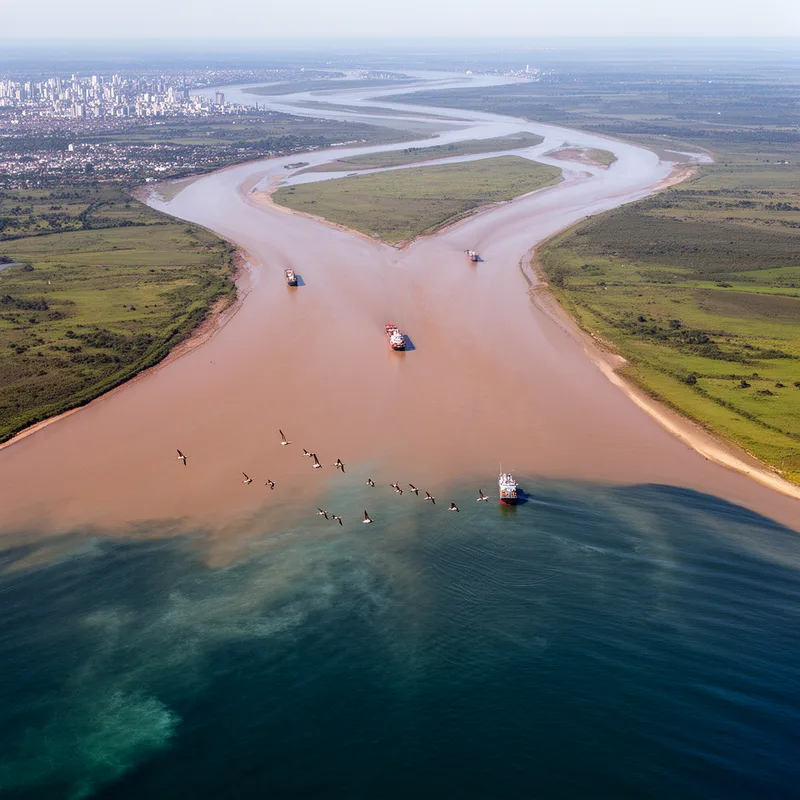
La Plata
- proper noun
- /lɑː ˈplɑːtə/
 :
La Plata
:
La Plata
- The waters of La Plata are influenced by both river and ocean currents.
Examples
-
Many migratory birds stop at La Plata during their seasonal journeys.
-
La Plata is known for its rich history.
-
The ship sailed up the La Plata estuary towards Buenos Aires.
-
Have you ever visited La Plata?
-
The Rio de la Plata is an important estuary where the Paraná and Uruguay rivers converge before entering the Atlantic Ocean.
-
Many ships sail through the Rio de la Plata, taking advantage of the wide channel created by the merging rivers.
-
Tourists often visit the Rio de la Plata to enjoy its scenic beauty and the vibrant culture of the surrounding regions.
Synonyms

A wide river mouth between Argentina and Uruguay where two rivers meet the ocean
A wide bay between Argentina and Uruguay where the Paraná and Uruguay rivers meet and flow into the Atlantic Ocean
Surface Forms
Morphology
La + Plata
This is a toponym composed of Spanish elements ('la' + 'plata') whose literal sense is 'the silver' rather than an estuary; knowing the constituent words would not lead a B1 English learner to infer the specific geographic meaning (an estuary on the Argentina–Uruguay border). As a proper name with historical/place-specific reference, its referential meaning is not compositionally derivable from the parts, so it is opaque to learners.
Etymology
The name La Plata comes from the Spanish words la and plata, which mean 'the' and 'silver'. Early Spanish sailors believed the rivers inland held silver, so they called the wide river the 'River of Silver'. That's why the big river mouth is still called La Plata today.

