
La Paz
 7
1.9

- proper noun
- /lɑː pɑːz/
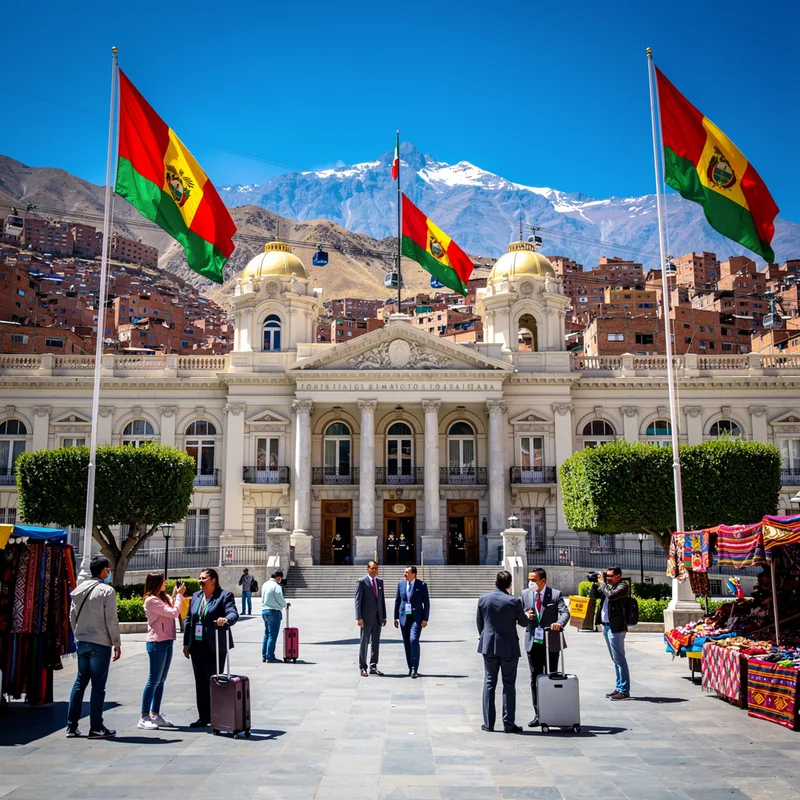
- La Paz is the administrative seat of Bolivia's government, making it an important city in La Paz.
Examples
-
At one point, I found myself in La Paz in a room full of lawyers asking for my advice on reforming the Bolivian penal system.
Academic text (2003) -
The enchantment begins with an early morning arrival in La Paz.
Academic text (2004) -
No visit to La Paz would be complete without exploring them, so I set out on the second day to do just that.
Academic text (2004) -
You want to follow your friends to La Paz, Bolivia?
-
I've always had this idea that I want to be a chef in a hotel in La Paz.
Fiction book (2002) -
La Paz is built in a crater-like valley of the altiplano or high plain.
Academic text (2004) -
The blanket will be sold at the handicraft market in La Paz, which is frequented by tourists from all over the world.
Academic text (2004) -
In protest, over 3,000 peasant farmers set out to march 360 miles from their fields in Cochabamba to the capital, La Paz.
-
I wanted to revisit the magical places of that year—La Paz, Tiahuanaco, Lake Titicaca—to see if they were as good as I remembered them.
Academic text (2004) -
Tourists flock to La Paz to experience its vibrant culture and stunning landscapes.
Surface Forms
Morphology
La + Paz
La Paz is a lexicalized toponym whose referent (the Bolivian administrative capital) cannot be derived from the constituent Spanish words 'La' and 'Paz'. Even if a learner recognizes them as 'the' + 'peace', that literal composition does not predict that the phrase names a specific city, and place names are typically arbitrary across languages.
Etymology
La Paz was named by Spanish settlers and comes from La + Paz, which means 'the peace'. One popular story says it was given this name when a local conflict ended, so the city's name remembers 'peace' today.