
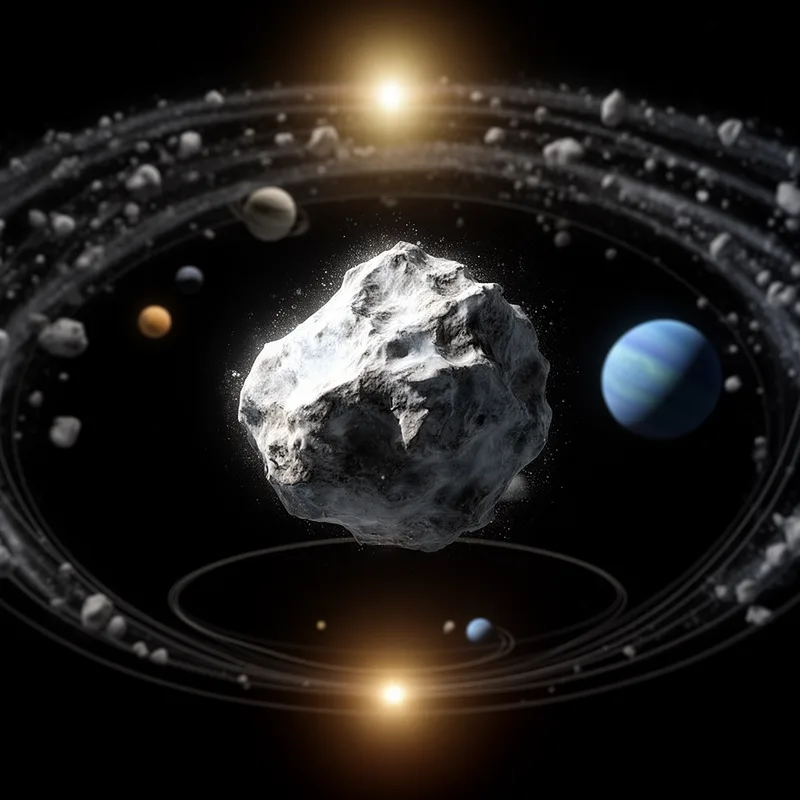
Kuiper belt object
 1
9.9
1
9.9

- noun
- /ˈkaɪpər bɛlt ˈɑbdʒɛkt/
- Specialized
- Some experts wonder whether major Kuiper Belt objects should be classified as planets due to their size and characteristics.
- other Kuiper belt objects
Examples
-
Some Kuiper belt objects are half the size of Pluto, leading many astronomers to question Pluto's planetary status.
Academic text (2003) -
It's going to be able to observe everything from Mars out, so planets, moons, asteroids, Kuiper belt objects, comets.
-
Scientists hope such details will help them better understand Kuiper Belt objects as they study the outer solar system.
-
Rapid all-sky imaging will uncover supernovae, potentially hazardous near-Earth asteroids, and distant Kuiper Belt objects that we have yet to explore.
Synonyms
 1
9.8
1
9.8
A small object that orbits the Sun beyond Neptune in the Kuiper belt
How Distant

Surface Forms
Morphology
The nouns 'belt' and 'object' are transparent and the phrase compositionally denotes an object in a named belt, but 'Kuiper' is a proper name referring to a specific astronomical region beyond Neptune and does not convey that meaning to learners without domain knowledge. Because the precise sense (a small body orbiting in the Kuiper Belt) depends on specialized knowledge of the proper name rather than predictable composition, the expression is only partially transparent to a B1 learner.
Etymology
The noun Kuiper belt object is named after the scientist Kuiper and the picture of a belt — a ring of small icy bodies far beyond Neptune. So a Kuiper belt object is a small object that goes around the Sun in that distant 'belt'.