
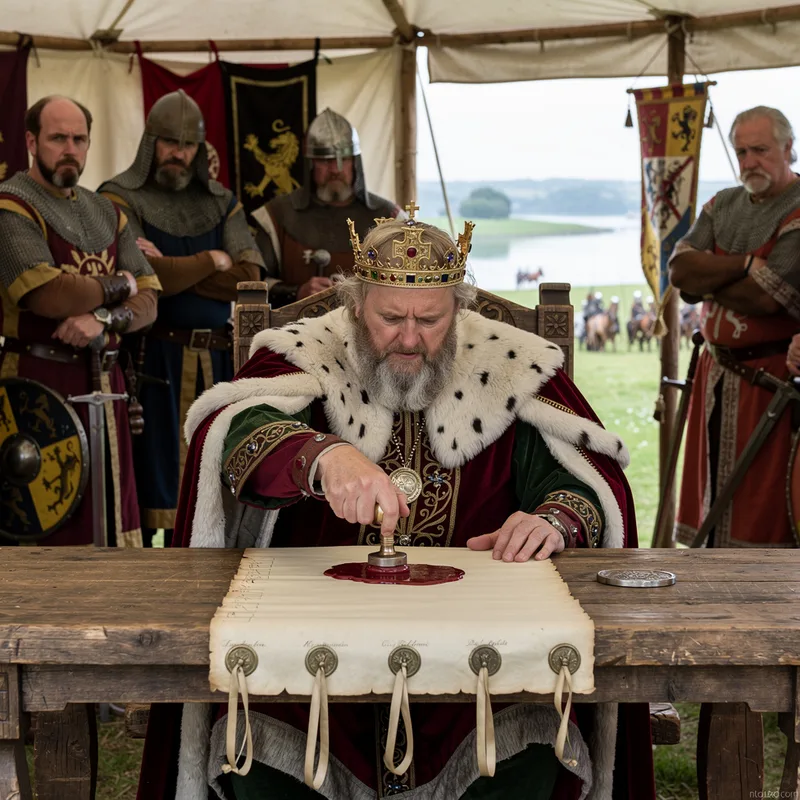
King John
 1
5.6
1
5.6

- proper noun
 :
Rey Juan
:
Rey Juan
- The four surviving copies of King John's Magna Carta were going on display together.
Examples
-
With the help of these highly trained warrior monks, King John and his royal army were eventually defeated.
-
England, in the year 1215, had been under the reign of King John for 16 years.
-
When King John drove out the Mamelukes and came to our village, he found dreadful things.
-
At breakfast, we were told by the innkeeper that King John had once stayed in this hotel and, moreover, had slept in the very room where we had spent the night.
Fiction book (1998) -
Magna Carta began as a peace treaty to end a civil war between King John and the English barons, but it has become one of the foundational documents of Anglo-American legal.
Academic text (2016) -
Conflicts with Pope Innocent III over clerical privileges eventually led to King John's acceptance of several papal directives, including the establishment of a fund from the city's treasury for students to attend Oxford.
Academic text (1993) -
On June 15, 1215, in a field at Runnymede, King John affixed his seal to Magna Carta.
-
England, in the year 1215, had been under the reign of King John for 16 years.
Synonyms
 200
2.7
200
2.7
The English king from 1199 to 1216 who was forced to sign the Magna Carta in 1215
King of England from 1199 to 1216 who signs the Magna Carta and loses lands in France
Surface Forms
Morphology
The phrase is compositionally predictable as 'a king named John' because 'king' + the proper name 'John' follow a standard naming pattern that a B1 learner would understand. However, the specific historical identity and details (King of England 1199–1216, Magna Carta) are world-knowledge that cannot be derived from the constituent words, so full meaning is not recoverable from constituents alone.
Etymology
King John was King of England from 1199 to 1216 who was forced by powerful nobles to sign the 'Magna Carta' in 1215. Imagine a king made to put his mark on a paper while nobles stand over him — that image helps explain why we remember him as the ruler who had to accept limits on his power.