
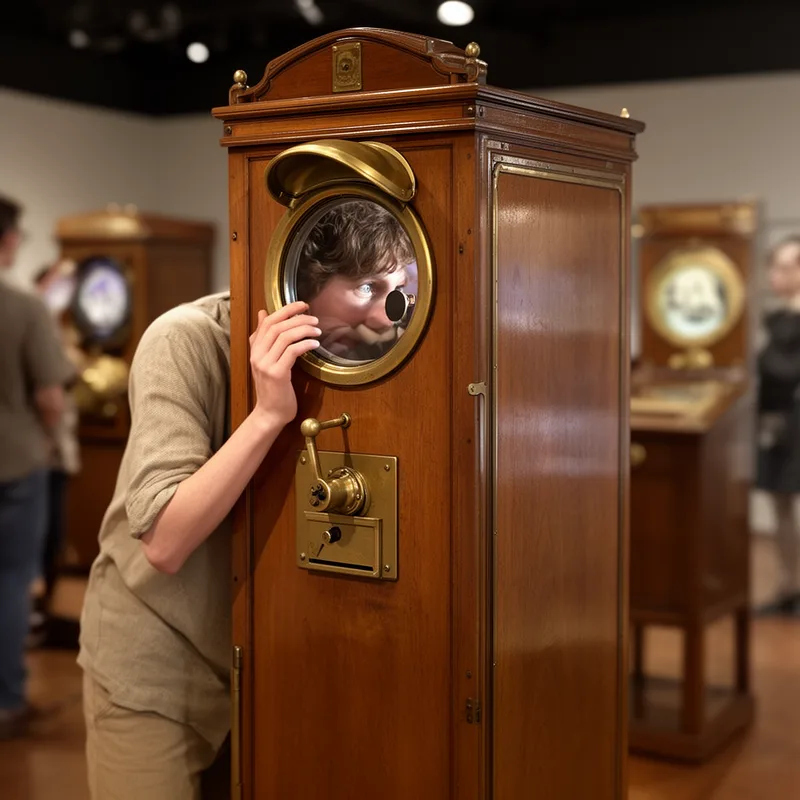
Kinetoscope


 1
9.9
- noun
- /ˈkɪnɪtəˌskoʊp/
- Archaic
- The early actualities, early short non-fiction films that were shown in small shops around America when movies were still sort of taking off in the kinetoscope form—a lot of those things were attractive to people because they showed them reality in ways that they had never experienced before.
- Edison's Kinetoscope
Examples
-
Perhaps this lack of visual access is merely a function of the medium in question; in the kinetoscope, the moving image was viewed within a cabinet, with the movement initiated by a handle that the viewer cranked.
Academic text (2011) -
This is a parlor franchised by the Edison Kinetoscope Company. "How long are your films?" "Approximately twenty seconds.
Fiction book (1993) -
That night, Paul had a dream about the Kinetoscope pictures.
Fiction book (1993) -
He's taking advantage of the novelty and selling Kinetoscope exhibition rights for entire states, nothing less.
Fiction book (1993) -
Moreover, even if we set aside for a moment this aspect of the etching, one might still reasonably wonder if it truly "celebrates" the kinetoscope, as Mathews argues.
Academic text (2011) -
Edison's Kinetoscope used a continuous strip of film instead of cards, but the effect in all the machines was similar: the illusion of motion from a sequence of rapidly flashed stills.
Fiction book (1993) -
Although the walls of the Kinetoscope parlor were a bilious brown, management had provided plenty of electric light as well as a rail in front of each row of machines for the comfort of patrons leaning forward over the eyepiece.
Fiction book (1993) -
The kinetoscope allowed audiences to enjoy a moving picture through a small viewer.
-
Invented by Thomas Edison, the kinetoscope lets one person watch a short film continuously.
-
In the past, the kinetoscope brought early films to life, captivating viewers with its motion.
Surface Forms
Morphology
Etymology
The word Kinetoscope comes from Greek parts kine- meaning 'movement' and -scope meaning 'to look'. So it is like a small 'telescope' for movement, a machine you look into to see moving pictures.