

Kennelly-Heaviside layer
- noun
- Specialized
 :
capa Kennelly-Heaviside
:
capa Kennelly-Heaviside
- Early radio operators relied on the Kennelly-Heaviside layer to bounce signals beyond the horizon.
Examples
-
At night, the Kennelly-Heaviside layer becomes more reflective, affecting radio communications.
-
Scientists discovered that the Kennelly-Heaviside layer plays a crucial role in long-distance radio transmission.
-
The Kennelly-Heaviside layer plays a crucial role in radio communication.
-
Can you explain the Kennelly-Heaviside layers to me?
-
At night, the Kennelly-Heaviside layer reflects radio waves, improving long-distance communication.
-
Early radio operators utilized the Kennelly-Heaviside layer to transmit messages across vast distances.
-
The Kennelly-Heaviside layer is essential for ensuring efficient radio wave transmission over the Earth.
Synonyms
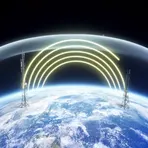
A layer high above Earth that bounces back radio waves for long-distance radio

Part of the upper atmosphere 50 to 90 miles above Earth that reflects medium radio waves
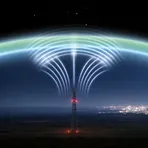
A layer of the upper atmosphere about 80 to 145 kilometres above the ground that reflects medium-length radio waves
Surface Forms
Morphology
Kennelly-Heaviside + layer
This is an eponymic technical term: the constituent 'Kennelly-Heaviside' is a proper name and gives no semantic cue to radio-wave reflection, while 'layer' only supplies the general idea of a stratum. A B1 learner who knows the individual words could infer it denotes a particular layer but could not derive the specific meaning (the ionospheric region that reflects medium‑length radio waves), so the expression is only partly transparent.
Etymology
Kennelly-Heaviside layer is named after two scientists, Kennelly and Heaviside, who pictured a high, thin 'sky mirror' that can bounce radio waves back to Earth. That image explains why the name now means the part of the upper air that 'reflects' medium-length radio signals.

