
KBO
 1
9.8
1
9.8

- noun
- /ˈkeɪˌbiˈoʊ/
- Specialized
- The classification of a newly found KBO can provide valuable insights into the formation of the solar system.
- KBO like Pluto
Examples
-
Just because Pluto was the first KBO to be discovered does not make it special.
Blog text (30) -
Why is Pluto special just because it was discovered decades before any other KBO?
Blog text (30) -
As far as anyone could tell, Pluto resembled just another KBO far more than it resembled a planet.
Blog text (28) -
Prior to the discovery of Eris et al., there were questions about whether it was reasonable to include Pluto as a planet, because it seemed to be more like just a large KBO than like any of the other eight planets.
Blog text (28) -
Hence the need for a precise definition in the first place. If I understand correctly, it was the fact that Pluto resembled just another KBO more than it did the other eight planets that created the driving force to get a definition that excluded Pluto.
Blog text (28) -
The Kuiper Belt is home to many intriguing KBOs that continue to be studied by astronomers.
-
Astronomers are excited to discover more KBOs in the distant regions of our solar system.
Synonyms
 1
9.9
1
9.9
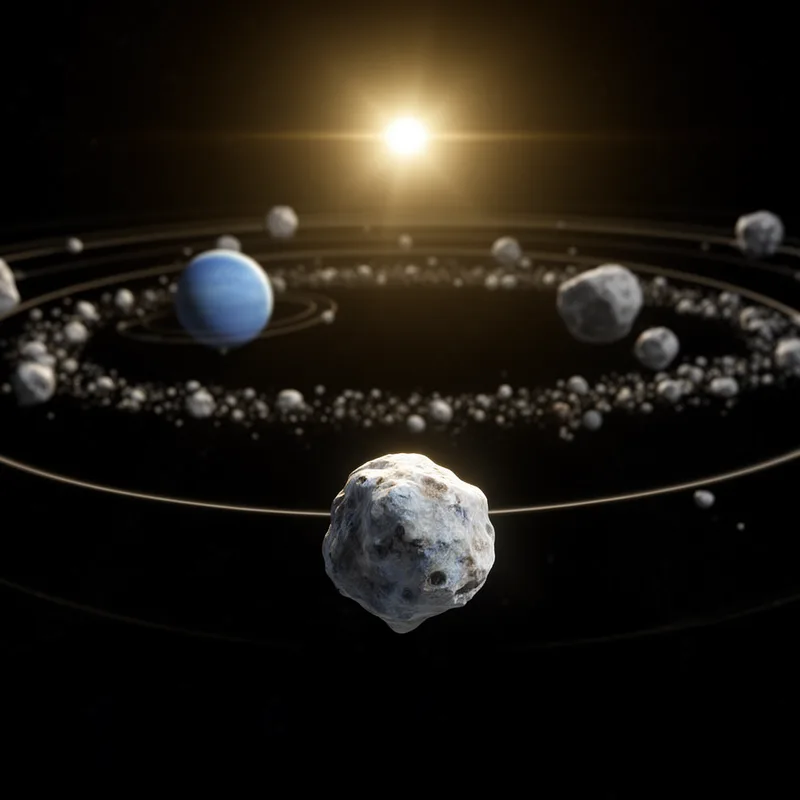
A small icy or rocky body that orbits the Sun beyond Neptune
Surface Forms
Morphology
KBO = K + B + O
KBO is an initialism (Kuiper Belt Object); the letters are not productive English morphemes, so the meaning cannot be derived from the form without knowing the expansion.
Etymology
KBO is short for Kuiper Belt Object, named after the astronomer Kuiper, and belt here means a ring or 'belt' of small bodies beyond Neptune. So a KBO is a small object that orbits the Sun in that outer belt.