

Juniperus flaccida
- noun
- Specialized
- The Juniperus flaccida can be identified by its distinctive drooping branchlets.
Examples
-
The weeping juniper, or Juniperus flaccida, is well-suited to dry climates with its resilience.
-
Researchers observed that Juniperus flaccida thrives in the mountainous regions of northern Mexico.
-
Many birds use the Juniperus flaccida as shelter due to its dense, spreading branches.
-
The Juniperus flaccida thrives in arid conditions.
-
Many gardeners appreciate the Juniperus flaccida for its unique appearance.
-
The Juniperus flaccida is often planted in gardens for its attractive, drooping branches.
-
In western Texas, the Juniperus flaccida provides habitat for various bird species.
Synonyms
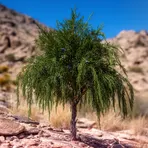
A small tree with spreading branches and drooping twigs that grows in western Texas and the mountains of Mexico
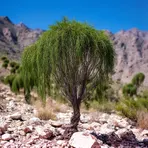
A small evergreen tree with thin hanging branches that grows in western Texas and Mexican mountains
Surface Forms
Morphology
Juniperus + flaccida
This is a scientific binomial (genus + Latin epithet) that is compositionally descriptive: Juniperus names the genus of conifers and flaccida (Latin) denotes a drooping/flaccid quality, so together they mean a 'weeping/drooping juniper'. Because the epithet is Latin and not a normal English word (and is listed as not found in the dictionary), the meaning is only partially predictable for typical learners, making the transparency partial rather than fully transparent.
Etymology
Juniperus flaccida gets its name from the Latin word flaccida, which means 'drooping'. This describes the tree's long, hanging branchlets and spreading branches, so it is also called the 'weeping juniper', a helpful image to remember what the tree looks like.

