
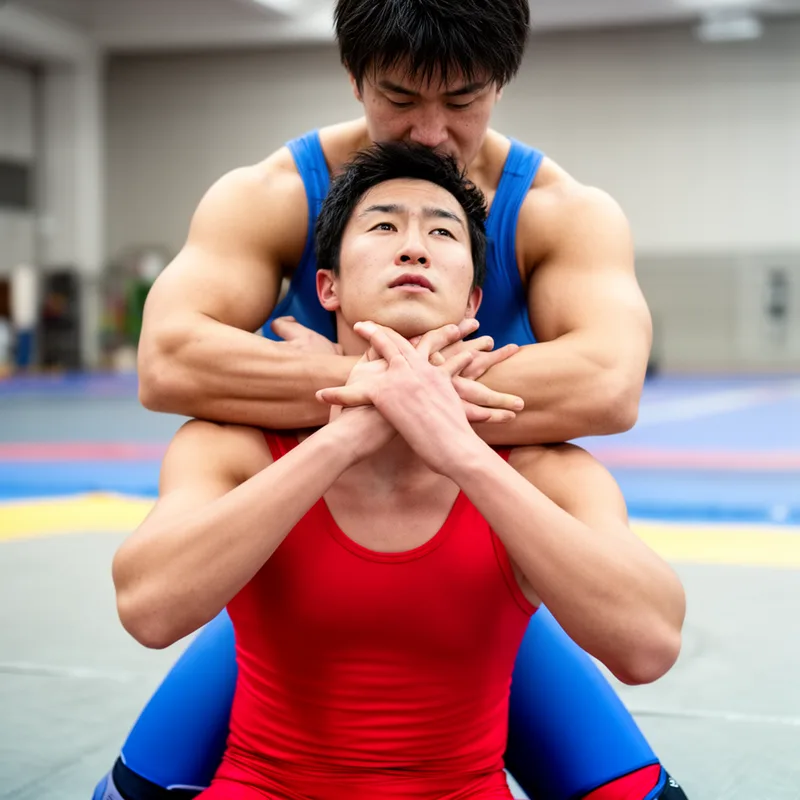
Japanese stranglehold
- noun
- Jargon
- The wrestler applied a tight Japanese stranglehold to secure the victory.
Examples
-
She escaped from the Japanese stranglehold with a swift counter move.
-
The wrestler secured a Japanese stranglehold that brought his opponent to the mat.
-
Mastering the Japanese stranglehold requires both strength and precision.
-
He learned the Japanese stranglehold during his training sessions.
-
The wrestler secured a Japanese stranglehold that brought his opponent to the mat.
-
Mastering the Japanese stranglehold requires both strength and precision.
-
He learned the Japanese stranglehold during his training sessions.
Synonyms

 7
7.5
7
7.5

A tight arm around someone's neck from behind to stop them moving or make them pass out
 7
7.4
7
7.4
A tight grip around a person's neck that makes it hard to breathe or move
 1
7.9
1
7.9
A tight arm grip around the neck that stops someone breathing
Surface Forms
Morphology
The phrase is a straightforward adjective + noun combination: a 'stranglehold' is already a hold that compresses the windpipe, and 'Japanese' simply specifies its style or origin. A B1 learner who knows both words can therefore infer it denotes a Japanese-style stranglehold (i.e., a type of choking hold), even if they might not know the exact technical arm position.
Etymology
Japanese stranglehold likely comes from Japanese fighting styles, where a fighter crosses their arms around an opponent's throat and squeezes so the person cannot breathe. That's why the name, with strangle and hold, describes a fighting move that 'chokes' an opponent.