

Japanese rose
- noun
- Many gardeners use the Japanese rose as a rootstock for grafting other types of roses.
Examples
-
The Japanese rose is often planted in gardens for its hardiness and lovely blooms.
-
She decided to use a Japanese rose hedge to add privacy to her yard.
-
The Japanese rose blooms beautifully in spring.
-
I planted a Japanese rose in my garden.
-
Many gardeners use the Japanese rose as a rootstock for grafting other types of roses.
-
The Japanese rose is often planted in gardens for its hardiness and lovely blooms.
-
She decided to use a Japanese rose hedge to add privacy to her yard.
Synonyms

 469
1.0
469
1.0

A bush with bright, often scented flowers and thorns
 5
1.0
5
1.0
A bush that grows roses

A fast-growing rose with many small flowers in clusters often used for hedges

A rose that grows fast and makes many small flower clusters
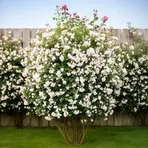
A strong rose plant that makes many small flowers in groups, often used for hedges or to support other roses

A small rose bush that grows strongly and makes many small flowers used for hedges and grafting
Surface Forms
Morphology
The compound is a simple demonym + noun where 'Japanese' indicates origin/association with Japan and 'rose' names the ornamental shrub, so the overall meaning ('a rose variety from Japan / associated with Japan') is directly derivable from the parts. This descriptive, compositional pattern is cross-linguistically common and would be immediately understandable to a B1 learner who knows both constituents, despite horticultural specifics in the full definition.
Etymology
Japanese rose is the name given to a strong rose that comes from Japan and nearby countries. It grows into thick bushes and gardeners often use it as a 'hedge' or as 'rootstock', the 'base' to graft other roses, so the name now means a hardy rose plant used for hedges or grafting.