
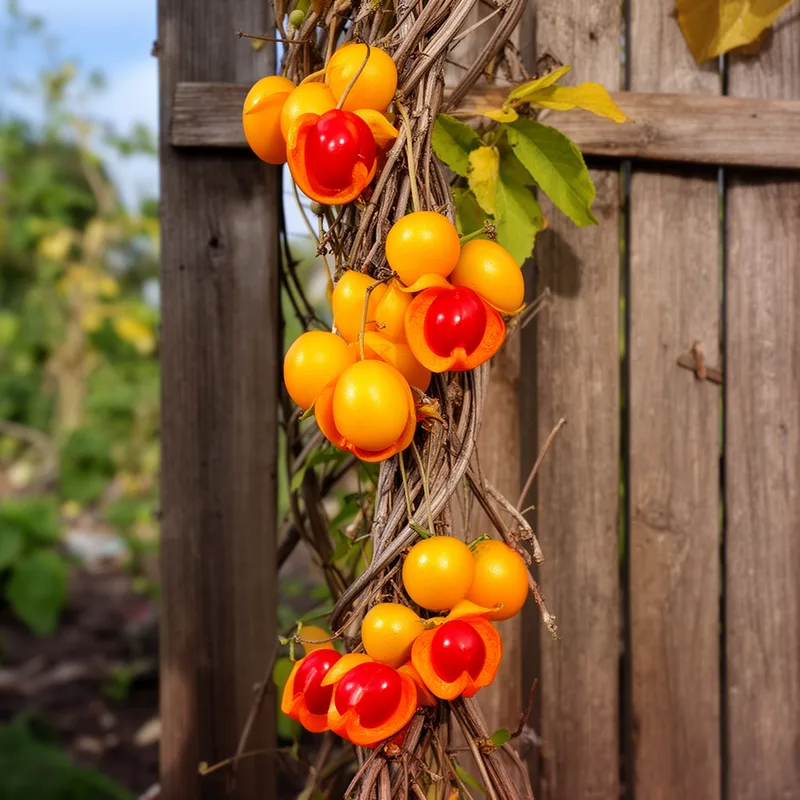
Japanese bittersweet
- noun
- /ˈdʒæpəˌniːz ˈbɪtərˌswit/
- US
- Gardeners prize Japanese bittersweet for its colorful autumn berries.
Examples
-
The Japanese bittersweet has become an invasive species in some American forests.
-
We found a tangle of Japanese bittersweet growing along the old fence.
-
I saw Japanese bittersweet growing along the fence.
-
The Japanese bittersweet adds vibrant colors to the garden.
-
Gardeners prize Japanese bittersweet for its colorful autumn berries.
-
The Japanese bittersweet has become an invasive species in some American forests.
-
We found a tangle of Japanese bittersweet growing along the old fence.
Synonyms
A climbing Asian vine with bright orange berries often grown in gardens

A climbing plant from Asia with orange berries and red seed covers

A climbing Asian vine with bright orange fruits and red seeds that often takes over native plants

A climbing plant with orange-yellow fruit showing a red seed covering in autumn
Surface Forms
Morphology
This is a straightforward composition of the adjective 'Japanese' (origin/connection with Japan) + the noun 'bittersweet' (a vine/shrub), so the overall meaning — a bittersweet plant from Japan/Asia — is directly derivable from the constituents. Nationality adjective + noun is a common, cross-linguistic pattern, making the phrase immediately comprehensible to learners who know both words.
Etymology
Japanese bittersweet gets its name from its bright orange berries: the outer, pretty covering looks 'sweet' while the seed inside tastes 'bitter'. Because of that clear contrast and because the plant is from Japan, the name now refers to this garden 'climbing vine'.

