
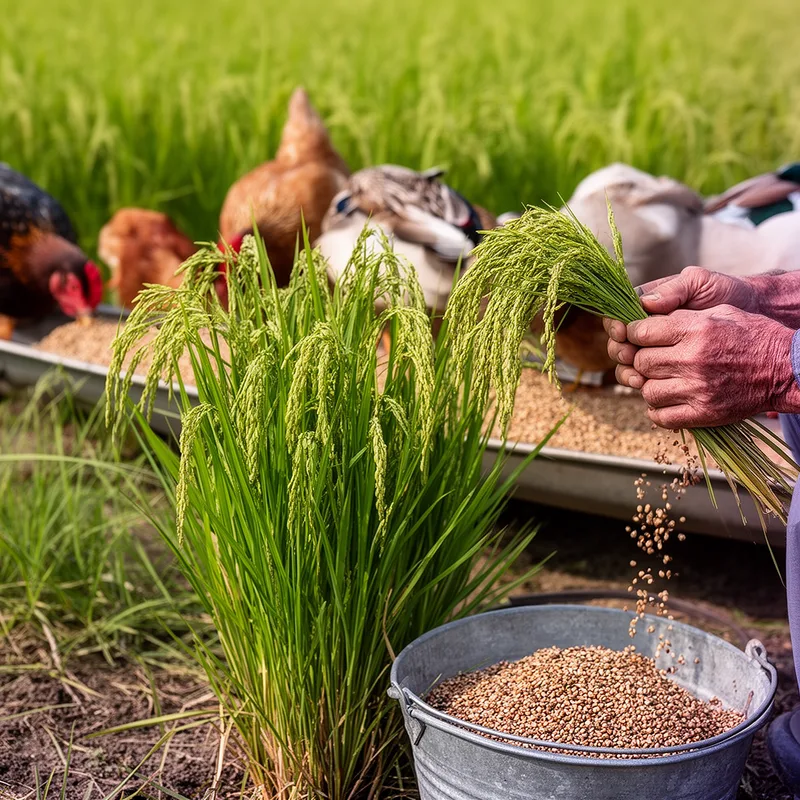
Japanese barnyard millet
- noun
- US
- Farmers in Japan often cultivate Japanese barnyard millet for both grain and livestock feed.
Examples
-
Wild ducks feed on Japanese barnyard millet seeds in wetland areas across the southern United States.
-
Researchers are studying Japanese barnyard millet as a drought-resistant alternative crop.
-
Farmers in Japan cultivate Japanese barnyard millet for animal feed.
-
Many wildlife enthusiasts plant Japanese barnyard millet in their gardens.
-
Farmers in Japan often cultivate Japanese barnyard millet for both grain and livestock feed.
-
Wild ducks feed on Japanese barnyard millet seeds in wetland areas across the southern United States.
-
Many wildlife enthusiasts plant Japanese barnyard millet in their gardens to attract birds.
Synonyms

A grass grown in Asia for its small edible seeds and for animal feed

A coarse grass grown each year for grain and to feed animals
A grass grown for its seeds and animal feed

A rough annual grass grown for edible seeds, animal feed, and wildlife food
How Useful
 698
1.0
698
1.0


- Specialized
- US
1
4.8
Surface Forms
Morphology
The phrase is a straightforward compositional noun phrase: 'Japanese' (origin), 'barnyard' (associated with livestock/animal feed), and 'millet' (a small-seeded grain). A B1 learner who knows these words can readily infer it refers to a type of millet used or grown in barnyards in Japan, so the meaning is transparently derived from its parts.
Etymology
Japanese barnyard millet may come from farmers in Japan who grew small millet in their barnyards to feed animals. That's why the name now refers to a coarse grass with edible seeds used as 'animal feed' and 'wildlife food'.