
James Monroe
 3
4.9

- proper noun
- /ˈdʒeɪmz mʌnˈroʊ/
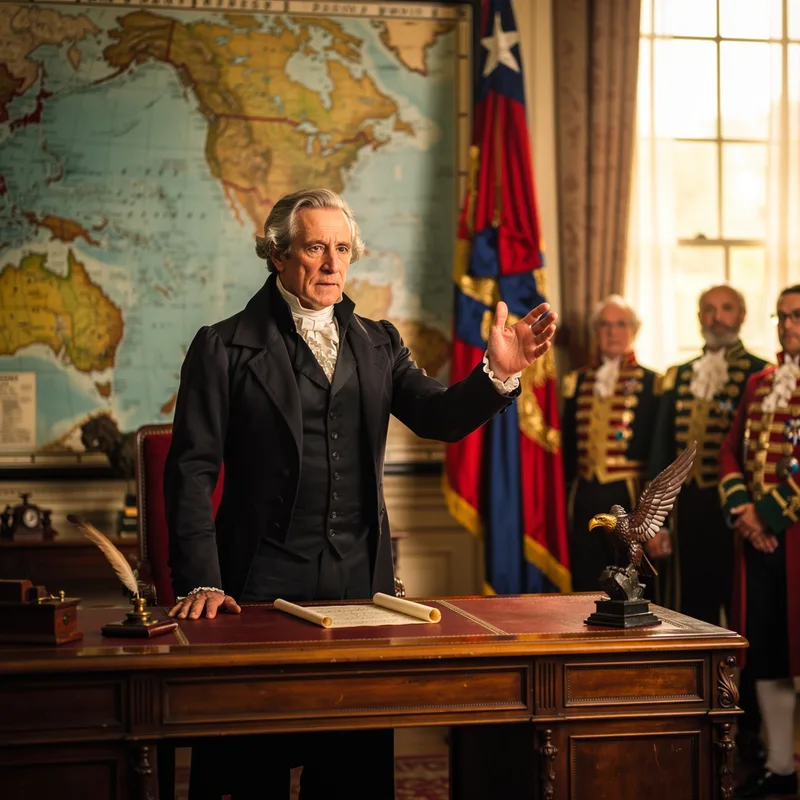
- James Monroe served as the fifth President of the United States from 1817 to 1825, during which he established the Monroe Doctrine.
Examples
-
James Monroe served two terms as the President of the United States in the early 19th century.
-
The James Monroe presidency is often associated with the 'Era of Good Feelings.'
-
The Monroe Doctrine, crafted under James Monroe, shaped American foreign policy for decades.
-
The policies of James Monroe shaped early American foreign affairs.
-
Did James Monroe really create the Monroe Doctrine?
-
In early America, presidents such as George Washington and James Monroe traveled by horseback or carriage to address crowds in person.
-
The design was adapted from an original design for a neoclassical English carpet of about 1815, the period of the furnishings acquired by President James Monroe for the Blue Room.
Surface Forms
Morphology
James + Monroe
This is a proper name referring to a specific historical person; knowing the constituent names 'James' and 'Monroe' does not let a B1 learner infer the referent is the fifth U.S. president or associated policies. Proper names are largely arbitrary and require world knowledge rather than compositional decoding, so the meaning is not derivable from the parts.
Etymology
James Monroe was the fifth President of the United States and is best remembered for the 'Monroe Doctrine', a firm warning that European countries should not try to control lands in the Americas. Think of him as the leader who drew a political 'fence' around the Americas, so his name often stands for that policy and the era he led.