
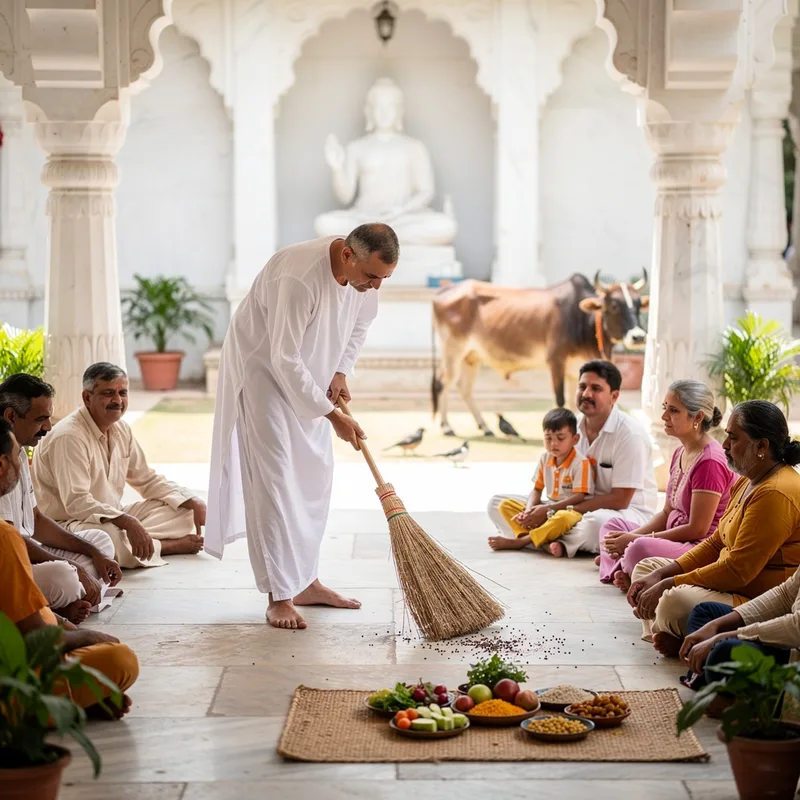
Jainism
 1
8.1

- noun
- /ˈdʒeɪnɪzəm/
- Gandhi, for example, drew his nonviolence from Jainism and his ideas of love and individual responsibility from Hinduism.
- Jainism and Buddhism
- Jainism and Hinduism
Loading YouTube…
Watch on YouTubeAnd the realized model also stems in Buddhism, Jainism, Sikhism, they're all following that same sort of umbrella.
- And the realized model also stems in Buddhism, Jainism, Sikhism, they're all following that same sort of umbrella.
Examples
-
The Judeo-Christian stewardship ethic makes humans directly accountable to God for preserving biodiversity, and strong environmental ethics also pervade Hinduism, Jainism, and Buddhism.
Academic text (1995) -
Before this particular Indian kingdom fell apart, it had played a major role in the development of Buddhism and Jainism.
Blog text (25) -
Jainism was also influenced by Magadha religious practices.
Blog text (25) -
In India, religions such as Buddhism, Sikhism, and Jainism have developed, creating individual techniques for the creation of peace within the mind.
Blog text (31) -
My own exploration of religious traditions has continued over the years with Islamic-Christian relations and, more recently, with Hinduism and Jainism.
Academic text (2014) -
Urban centers developed around 550 B.C., and this corresponds to the time period that Buddhism and Jainism were starting to take root in the land.
Blog text (25) -
Buddhism and Jainism do not believe in any sort of God at all—personal or otherwise.
Blog text (23) -
Hinduism, Buddhism, Jainism, and Sikhism believe instead that human beings each live many lifetimes on this earth (in fact, not all of one's various multiple reincarnations may be human ones, or even earthly ones).
Blog text (23) -
Similar formulations appear in Confucianism, Jainism, Buddhism, Hinduism, Christianity, Judaism, and Islam, as well as in the secular Western philosophy of such figures as Immanuel Kant and John Rawls.
Academic text (2005) -
Jainism teaches its followers to practice Jainism towards all living beings in their daily lives.
Surface Forms
Morphology
Jainism = Jain (transparent) = Jain + ism
Formed by the proper-name root 'Jain' plus the productive suffix '-ism' meaning 'system of belief', so the meaning is directly predictable.
Etymology
Jainism comes from Jain, which comes from the Sanskrit Jina, meaning 'conqueror' — someone who has overcome their own desires. The ending -ism means 'belief' or 'system', so Jainism is the 'way' or 'religion' of people who try to reach freedom from the cycle of rebirth by practising nonviolence and strict self-control.