
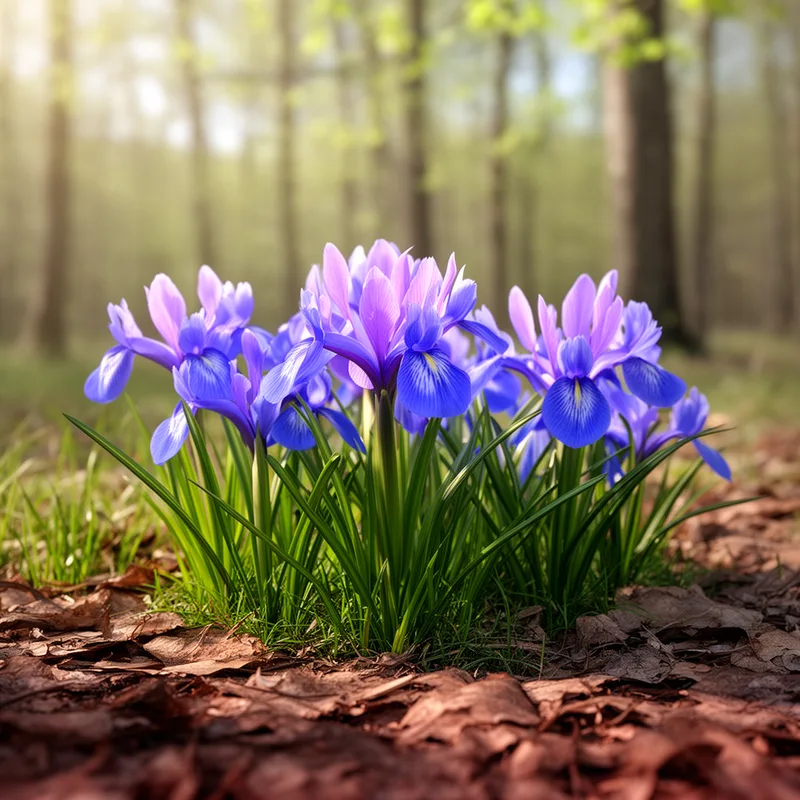
Iris verna
- noun
- Specialized
- Gardeners often plant Iris verna for its attractive blue-lilac blossoms and low maintenance.
Examples
-
Iris verna blooms early in the spring, brightening woodlands with its delicate flowers.
-
The native habitat of Iris verna includes dry woods and open fields across the eastern United States.
-
The Iris verna blooms beautifully in early spring.
-
Can you identify the Iris verna among these flowers?
-
Iris verna flowers add a vibrant splash of color to gardens in early spring.
-
Many people enjoy the sight of Iris verna thriving in their yards as it signals the arrival of warmer weather.
-
The delicate petals of Iris verna are particularly fragrant and attract various pollinators.
Synonyms
A low plant with bright blue-lilac flowers that blooms in spring
How Blue


Surface Forms
Morphology
iris + verna
This is a Latin botanical binomial combining 'iris' (a flower) with the epithet 'verna' (from Latin vernus, 'of the spring'). If a learner knew both constituent meanings and the convention that Latin species epithets describe a trait, they could infer 'a spring-flowering iris'. However, 'verna' is not an English word and species names follow scientific naming conventions rather than ordinary English composition, so the meaning is only partially predictable to a B1 learner.
Etymology
Iris verna comes from old words: Iris is a Greek word for 'rainbow' used for the flower, and verna is Latin for 'of spring'. So the name gives the idea of a small 'spring' iris with bright colors, which fits this low-growing plant that blooms early.