
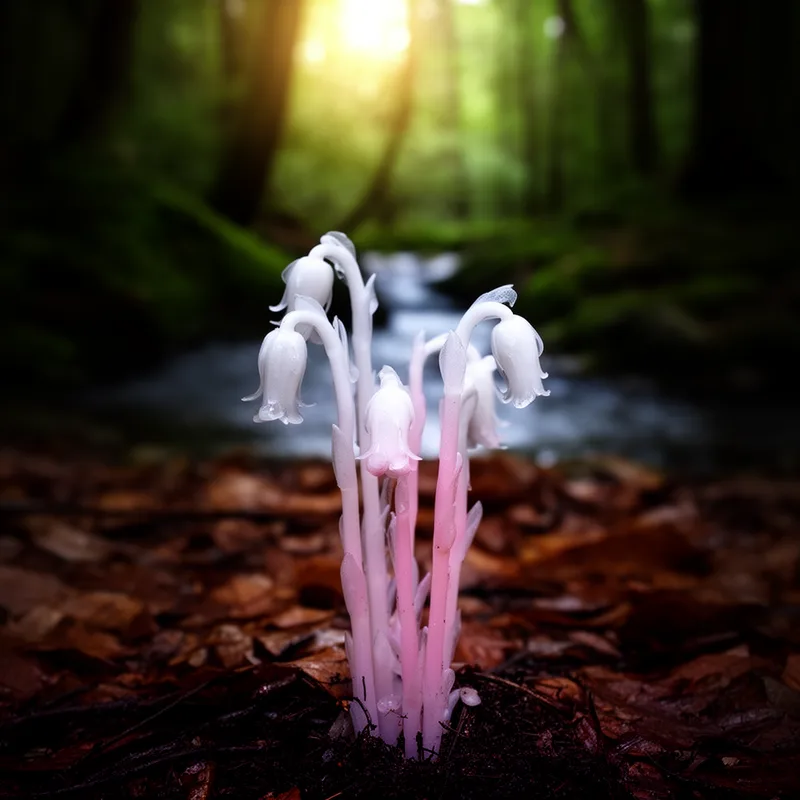
Indian pipe
- noun
- /ˈɪndiən paɪp/
Examples
-
The damp creek bank where Indian pipes grew.
Fiction book (1997) -
The ghost plant, AKA the Indian pipe, AKA the corpse plant.
-
Sometimes I have to fight back tears (and if you know me, you know I'm not predisposed to public weeping) because this makes me think about the plant friends Mike and I left behind: the fruit trees we planted; the orchids, ginger, and Indian pipe that grew in our woodlot; the Ponderosas in our field.
Blog text (13) -
In the quiet woods, clusters of Indian pipes can be found emerging from the damp earth.
-
During a hike, we spotted Indian pipes growing in the shade under tall trees.
-
The Indian pipe is unique because it lacks chlorophyll and has a delicate, waxy appearance.
Synonyms

Small pale plant that grows in dark woods, does not use sunlight, and gets food from dead plants

A small woodland plant with pale nodding flowers that grows on decaying wood
Surface Forms
Morphology
Indian + pipe
The name 'Indian pipe' is a conventional common name for a plant (Monotropa uniflora) that cannot be predicted from the literal meanings of 'Indian' and 'pipe'; a learner who knows those words would likely expect an object or something related to people from India/the Indigenous rather than a non-photosynthetic woodland plant. The relation between the constituents and the botanical meaning is arbitrary and culturally/historically specific, so the meaning is not derivable by a B1 learner from the parts alone.
Etymology
Indian pipe may come from the plant's look: it is white and shaped like a small smoking pipe, so people called it Indian pipe. That picture helps you remember a strange plant that has no green leaves and later turns black.

